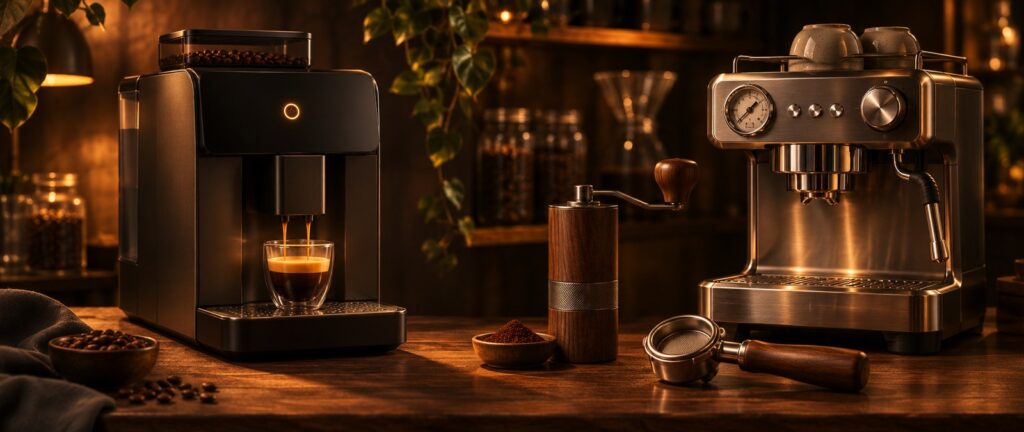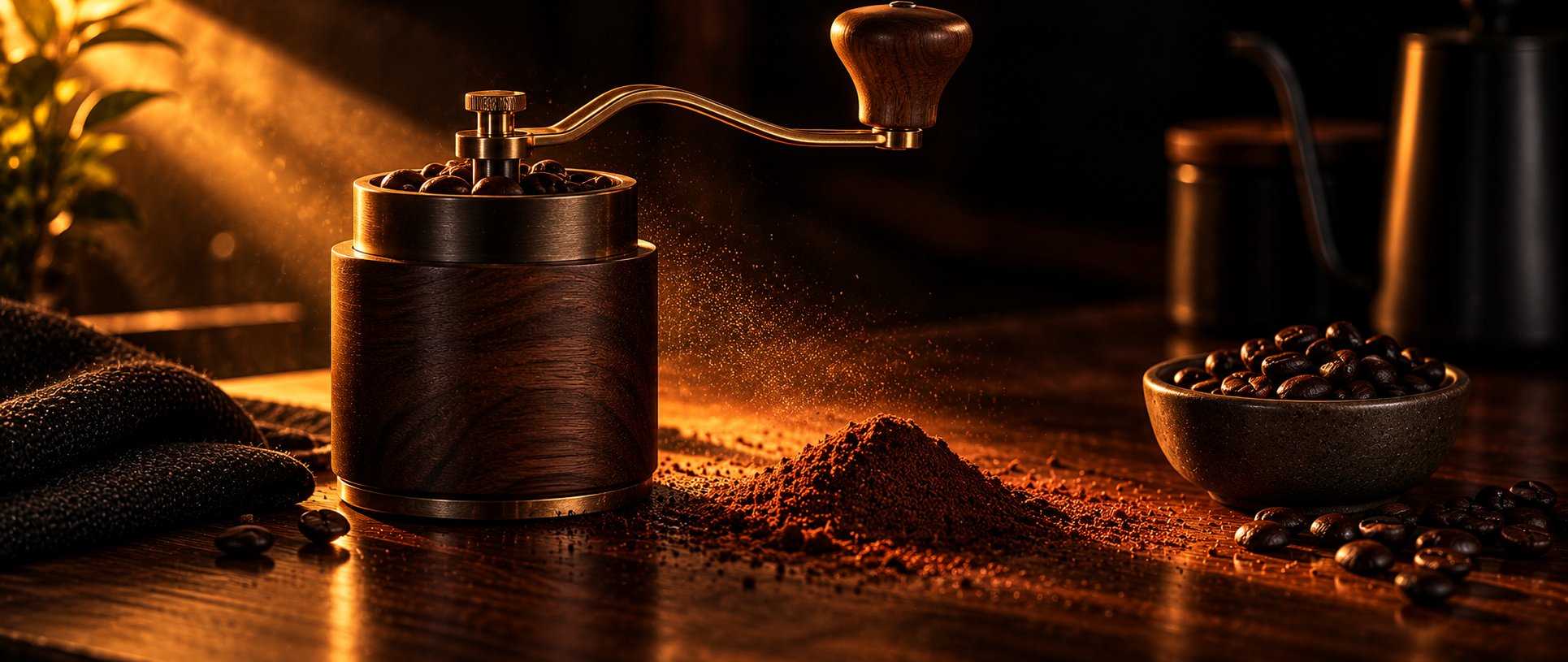
Under 100 euros, a burr grinder is a useful step up from a blade grinder, especially if you want more control over espresso extraction.
At this price you leave the reverse-burr world and enter entry-level manual conical grinders. A real grind control changes espresso: no more irregular powder and a more predictable extraction time.
This covers what you actually get, the two burr types, and what you do not need yet. Espresso grinders and their features are summarized in Wikipedia: Coffee grinder.
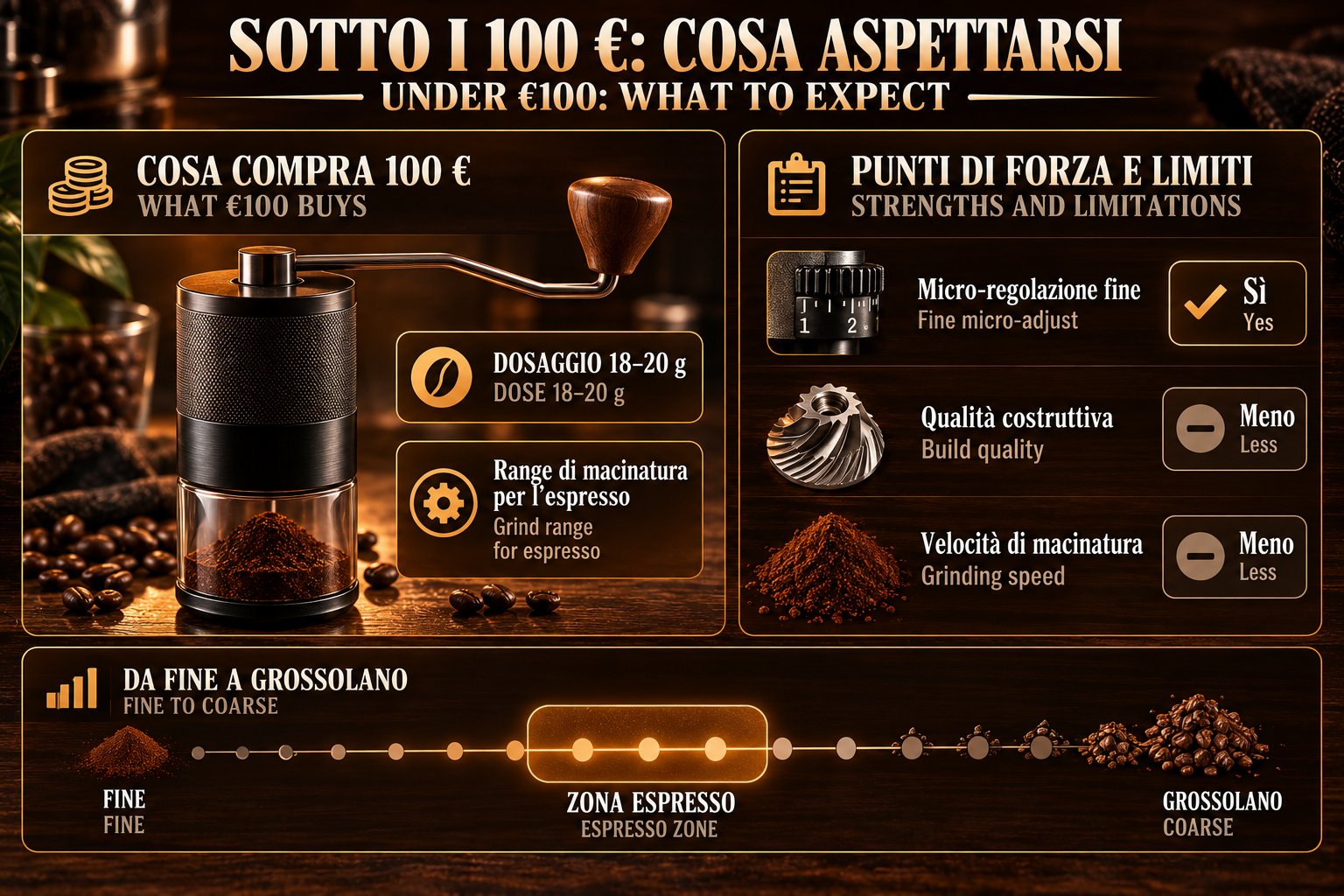
Table of contents
- Under 100 euros, the most rational choice for espresso is a well-built manual conical. It costs less, does not heat, and the grind quality is better than many electrics of the same tier.
- Flat burrs shear; all else equal they tend to a more even distribution. Conical burrs grind by friction and cost less. Build quality and adjustment matter more than burr shape.
- Buy on the quality of the adjustment, not the diameter on the box: a well-built 41 mm grinder beats a badly made 64 mm one.
- Grinding 18 g by hand takes about a minute: fine for one or two cups a day, slow if you make eight.
Coffee grinder: what you actually get under 100
In this range you usually buy an entry-level manual conical grinder or a low-tier electric one.
The manual conical
The references under €100 are precision manual conicals (e.g. Timemore C2, HelloGem), around 60–90 euros at list price. Do not confuse them with the Comandante C40: it actually lists around 220–270 euros (November 2026) and belongs to another budget.
It gives you a fine adjustment no electric under 150 euros matches. For espresso, the most rational choice under 100 euros is a well-built manual conical: burr shape alone (conical vs flat) says nothing about cup quality.
It costs less, does not heat, and the grind quality is better than many electrics of the same tier.
The electric conical
The electric conical costs more in this tier, heats the burr and has a shorter grind range.
What you do not get
The trade-off is speed: grinding 18 grams by hand takes a minute, and the motion is repetitive. If you make two coffees a day it is not a problem.
If you make eight, the manual slows you down and a mid-tier electric is worth considering.
You also do not get the perfect repeatability of a prosumer grinder: between one extraction and the next the burr can shift by a degree. You compensate by measuring dose and time.
Flat vs conical: the choice that counts
Flat burrs grind by shearing and give a more even distribution. The extraction is cleaner and the dial-in is more predictable.
Conical burrs grind by friction and cost less. But the distribution is wider and you taste more bitter spikes.
Under 100 euros, for espresso, a precision manual grinder is the right choice: same or lower cost, better grind than entry electrics. Burr shape (conical vs flat) is not a quality criterion by itself: build and adjustment are.
| Feature | Manual conical | Electric conical |
|---|---|---|
| Average price | €60–90 | €80–120 |
| Speed | ~1 min for 18 g | 10–15 s |
| Heating up | No | Yes, the burr heats |
| Distribution | Even | Wider |
| Adjustment | Fine, stepped | Often coarse |
| For whom | 1–3 cups, quality | Many cups, convenience |
Burr diameter is not the criterion
Under 100 euros you find 38, 41 and 64 mm burrs.
For espresso, under 100 euros, a 38–41 mm burr is already a step up from a 20 euro grinder. The larger cutting surface grinds more evenly and heats less.
Do not chase the marketing “64 mm” if the rest of the grinder (motor, adjustment, build) is weak.
A well-built 41 mm grinder beats a badly made 64 mm one. Judge the adjustment quality, not the diameter printed on the box.
What you do NOT need under 100
- A grinder with a digital timer as a first purchase: it is appreciated only once the base grind is already right.
- A separate burr container: in the entry tier it is an extra cost.
- A plastic-burr grinder: it is cheap but grinds poorly and wears out.
- “Dual use” moka + espresso as a priority: optimising for the moka worsens espresso.
- An electric under 80 euros: the weak motor heats and the grind range does not cover espresso.
Before you pay: the under-€100 checklist
In this band the main risk is buying a grinder that does not cover the espresso range. Before you pay, check these five points:
| Check | What you want | Why it matters |
|---|---|---|
| Burrs | Metal (steel), never plastic | Plastic wears and heats, grinds badly |
| Adjustment | Fine, small steps, down to fine espresso | If the steps are coarse you will not find the right grind |
| Grind range | Reaches fine espresso | Some grinders stop at “filter” and cannot do espresso |
| Manual or electric | Manual for 1–3 cups, electric if more | Speed only matters if you drink a lot |
| Noise | Check the dB if electric | 90 dB in an open kitchen in the morning is a lot |
If the grinder passes these five points, it is a good buy even at €90. If it misses one — above all the espresso range — the low price becomes a cost.
Our grinder picks (selected from official specs)
| Product | Spec | For whom | |
|---|---|---|---|
| Gaggia MD15 | Steel conical burrs | The honest automatic under 100 | View on Amazon |
| Comandante C40 MK4 | Nitro Blade conical burrs (not flat) | The reference hand grinder — but above this budget: ~€220–270 list (Nov 2026) | View on Amazon |
Choosing your grinder: the three-step method
- Decide the quantity. One or two cups a day, go manual. Many cups, consider a well-made electric conical.
- Check the adjustment range. It must cover the fine grind for espresso without coarse jumps.
- Read the reviews on repeatability, not speed. Two consecutive extractions coming out the same are worth more than a fast and imprecise grinder.
Then you measure dose and time with the scale — the grinder makes the difference, but only if you use it systematically.
In the how to make a good espresso section you find the complete dial-in, and in the coffee grinder for espresso section the guide to mid-tier grinders.
Updated: 26-10-2026
Frequently asked questions
Manual or electric coffee grinder under 100 euros?
Under 100 euros, the most rational choice for espresso is a precision manual conical: it costs less than a comparably built electric, doesn’t heat the coffee and adjusts finer.
An electric makes sense if you make many cups a day; under 80 euros the weak motor heats up and the grind range often doesn’t cover espresso.
Does the Comandante C40 cost under 100 euros?
No: at list price the Comandante C40 sits around 220–270 euros (November 2026), not under 100. It is often cited as the reference hand grinder, but it belongs to another budget.
Under 100, the widely referenced picks are manual conicals like the Timemore C2 or HelloGem: always check the current price.
What burr size do you need for espresso under 100 euros?
A 38–41 mm burr is already a step up from the grinder you get for €20: it grinds more evenly and heats less.
The real criterion is the quality of the adjustment, not the diameter printed on the box: a well-built 41 mm grinder beats a badly made 64 mm one.
Flat or conical burrs for espresso?
Under 100 euros, for espresso, the most rational choice is a well-built manual conical.
Burr shape alone says nothing about quality: all else equal, flat burrs tend to a more even distribution, but that is a tendency, not a law — a well-made conical beats a cheap flat.
Build and adjustment are what count.
More useful spares and accessories for this article
| Product | Feature | For whom | |
|---|---|---|---|
| Tipre scale with timer | 0.1 g / 2 kg, timer | Weigh dose and yield from day one | View on Amazon |
| Bialetti Moka Express 2-cup | Aluminium, Italian classic | The right size for one | View on Amazon |
| Borbone ESE pods Light 150 | Compostable, -50% caffeine | ESE without the sleepless night | View on Amazon |
| Gaggia Classic Pro | 58 mm brass group, parts everywhere | The buy-it-for-now upgrade | View on Amazon |
| 58 mm tamper | Steel, constant pressure | A flat, square tamp every time | View on Amazon |
| Flintronic TDS meter | Digital, ±2% | Measure your water first | View on Amazon |
| HG citric acid descaler | 500 ml, citric acid | Protect the machine every 3-6 months | View on Amazon |
| Set 12 porcelain cups | 80 ml, dishwasher safe | Espresso deserves proper cups | View on Amazon |
| Airtight jar 1.5 L | Steel, holds 650 g | The week's supply, sealed | View on Amazon |
| LAICA filter jug with timer | 2.3 L, digital timer, 1 filter | Less limescale water right away | View on Amazon |
As an Amazon Associate I earn from qualifying purchases. Note: some links on this site are affiliate links: if you buy through them, I may earn a commission at no extra cost to you. Affiliate links never influence my recommendations.