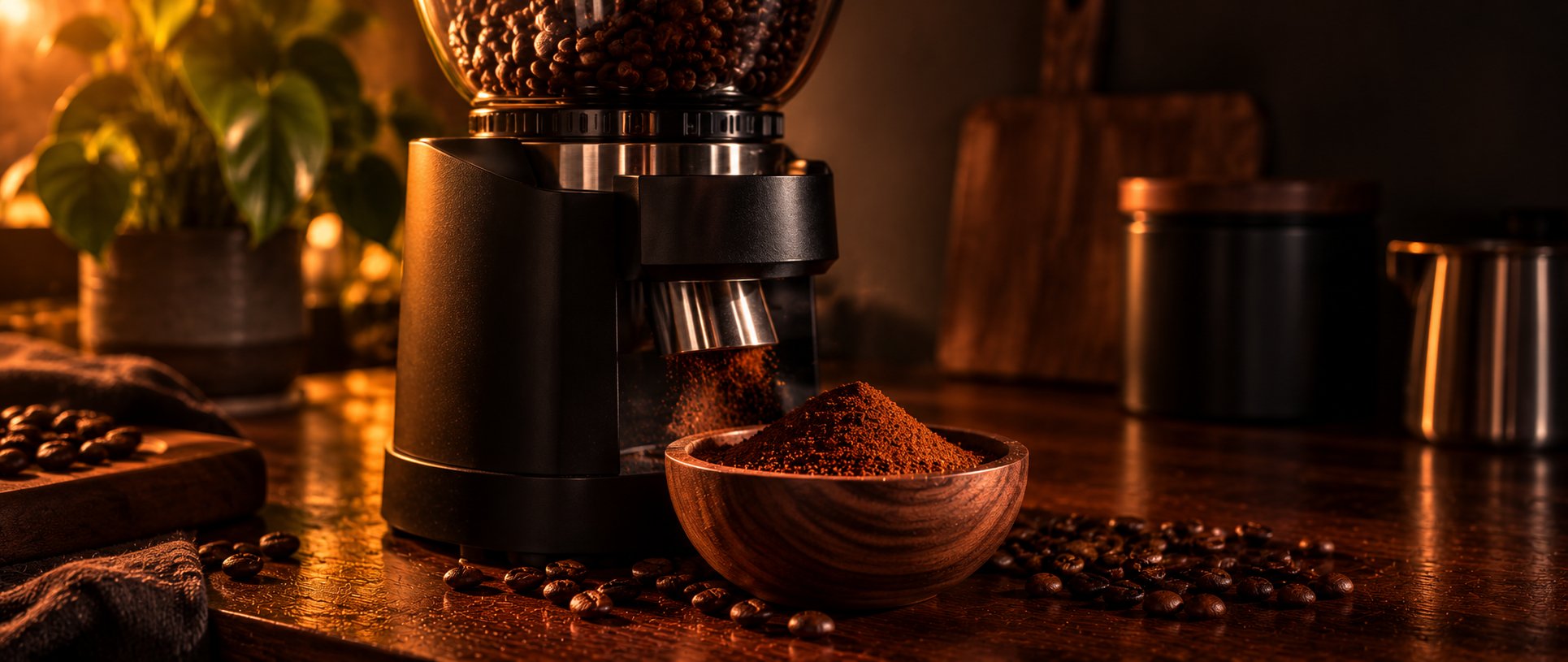
The espresso coffee grinder is the component that gets the least investment and matters the most: it decides how evenly the water moves through the dose. This guide explains the difference between flat and conical burrs, what to spend in each tier, and how to match the grinder to the machine you have. The rule to start from: uniformity of the grind is the whole game.
- Flat vs conical: at equal price, flat burrs give a more uniform grind; conical is the budget option and is fine in high-end models.
- Buy for your machine, not for the leftover budget: a 250 euro grinder on a 300 euro machine is the investment you taste.
- Never a blade grinder: random grain sizes cannot be dialed and the cup is always bitter.
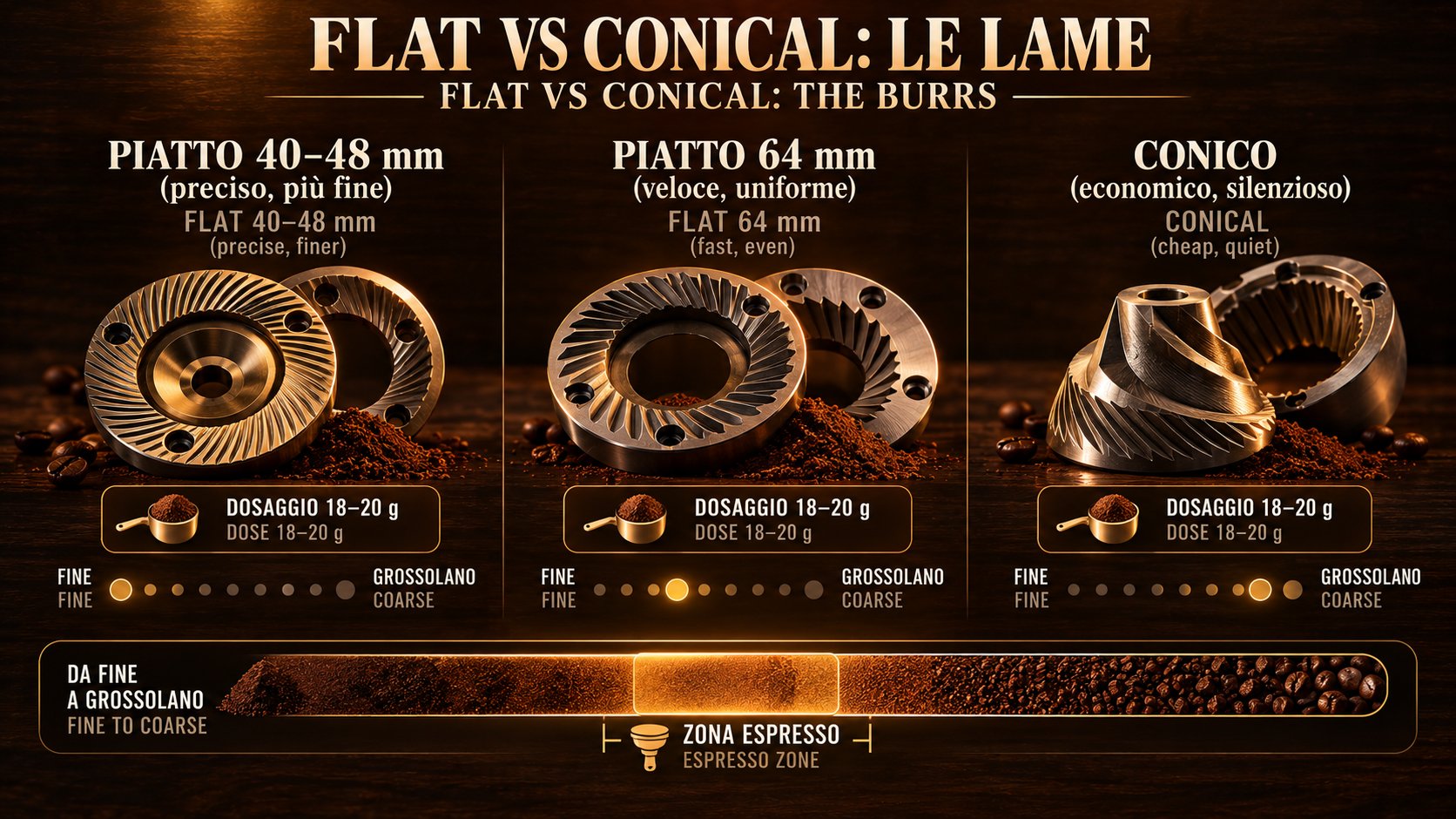
Espresso coffee grinder: flat vs conical burrs
Burrs come in two families, and the difference shows up in the cup: in extraction time and in how consistent the shot is.
Flat burrs
Flat burrs close like two concentric discs and cut the bean by shearing: at equal price the grind is more uniform, especially at the fine espresso settings.
The size of flat burrs defines the tiers: 40–48 mm is the value bracket — more uniform than conical, contained price, a bit of heat during grinding.
64 mm is the premium reference: competition-level uniformity, fewer fine fragments, roughly double the price.
Conical burrs
Conical burrs pull the bean downward between a cone and an outer drum. They are the budget option, versatile between filter and espresso. In high-end models they are more than enough for good espresso.
The manual conical grinder stays a niche for espresso. Grinding 18 g takes 60–90 seconds of cranking, and the grind is even but with more scatter at tight settings.
Heat buildup is a recurring argument: on well-made steel burrs it is contained, on ceramic burrs it is almost nil but the lifespan is shorter.
What is excluded
One whole category is out: the blade grinder, the 20–40 euro kitchen grinder. It produces grains of random size, extraction cannot be dialed, and the cup is always the same — bitter and inconsistent.
For espresso it is not an alternative; it is out of the conversation.
Dosing: by-hand or dose-control
Another axis of choice is dosing: by-hand, grinding straight into the portafilter or a cup, or dose-control, with a hopper and dispenser that grinds a weighed amount into a container.
By-hand keeps the grounds less exposed to air. Dose-control is more convenient for repeated doses.
Espresso coffee grinder by budget
This is what each price range delivers on average, and where each tier stands for espresso:
| Range | What you get on average | For espresso |
|---|---|---|
| 40–100 € | Basic electric conical | Possible, with a margin of error: imprecise setting, more fine fragments |
| 100–200 € | Refined conical or 40 mm flat | The serious entry point |
| 200–400 € | 48 mm flat with fine adjustment | The right tier for most homes |
| 400–800 € | 64 mm flat or premium conical, dose-control | Prosumer uniformity; the used market cuts prices |
| 800 € and up | Low retention, grind timer, premium burrs | For whoever dials in more than once a day |
A practical principle: size the grinder to the machine, not to the leftover budget. On a 300 euro machine, the 250 euro grinder is the investment you taste in the cup. On a 900 euro E61, the 100 euro grinder is the bottleneck.
And as with machines, the used market is alive: 64 mm flat grinders can be found at half price. Check the burrs, absent or minimal axial play, smooth adjustment.
Matching the espresso coffee grinder to your machine
Matching starts from the dose. A 58 mm portafilter works with 18–20 g.
You need a grinder with a sufficient hopper (200–300 g) and a dosing method that keeps the dose stable within ±0.2 g, whether by-hand into a cup or dose-control.
Machines with 54 mm portafilters use 14–16 g doses, where precision matters even more because the percentage error is larger.
If the machine is a superautomatic, the logic flips: the internal grinder does everything. An external grinder makes sense only for a second system, typically filter, or for a quality jump. In that case you buy the grinder for filter, not for espresso.
Practical details count as much as the burrs: footprint, noise, the hopper and the optional purge station.
Benchtop 64 mm models are 15–25 cm wide. A powerful grinder reaches 90–100 dB, hard to live with in an open kitchen. Empty the hopper daily so the coffee does not age inside.
In a small kitchen, by-hand into a 200 ml container beats a big hopper.
Last check: the grinder must keep pace with the machine. Two or three doubles a day stress nothing; whoever pulls ten shots a day for dial-in needs a motor that does not overheat.
The closing rule: a mid-tier flat-burr grinder with an entry machine beats almost any reversed combination. Buy in sequence — machine, grinder, scale — and upgrade each piece with the budget you have.
The specs of the individual accessories are in the tools section, the buying criteria in the equipment section. Grinder types and extraction parameters are summarized in Wikipedia: Coffee grinder.
Note: Some links on this site are affiliate links: if you buy through them we may earn a commission at no extra cost to you. Affiliate links are marked and never influence our recommendations.