You can find a semiautomatic espresso machine for less than 300 euros, but you’ll need to make some compromises. The important question is which features actually matter for the coffee you want to make.
58 mm portafilter, steam, and control you can feel in the extraction time.
In this range raw quality is not the issue — the components hold up. The problem is stability: how well the machine keeps group temperature from one shot to the next.
Below is what you actually get, the criteria that matter, and what you do not need yet.
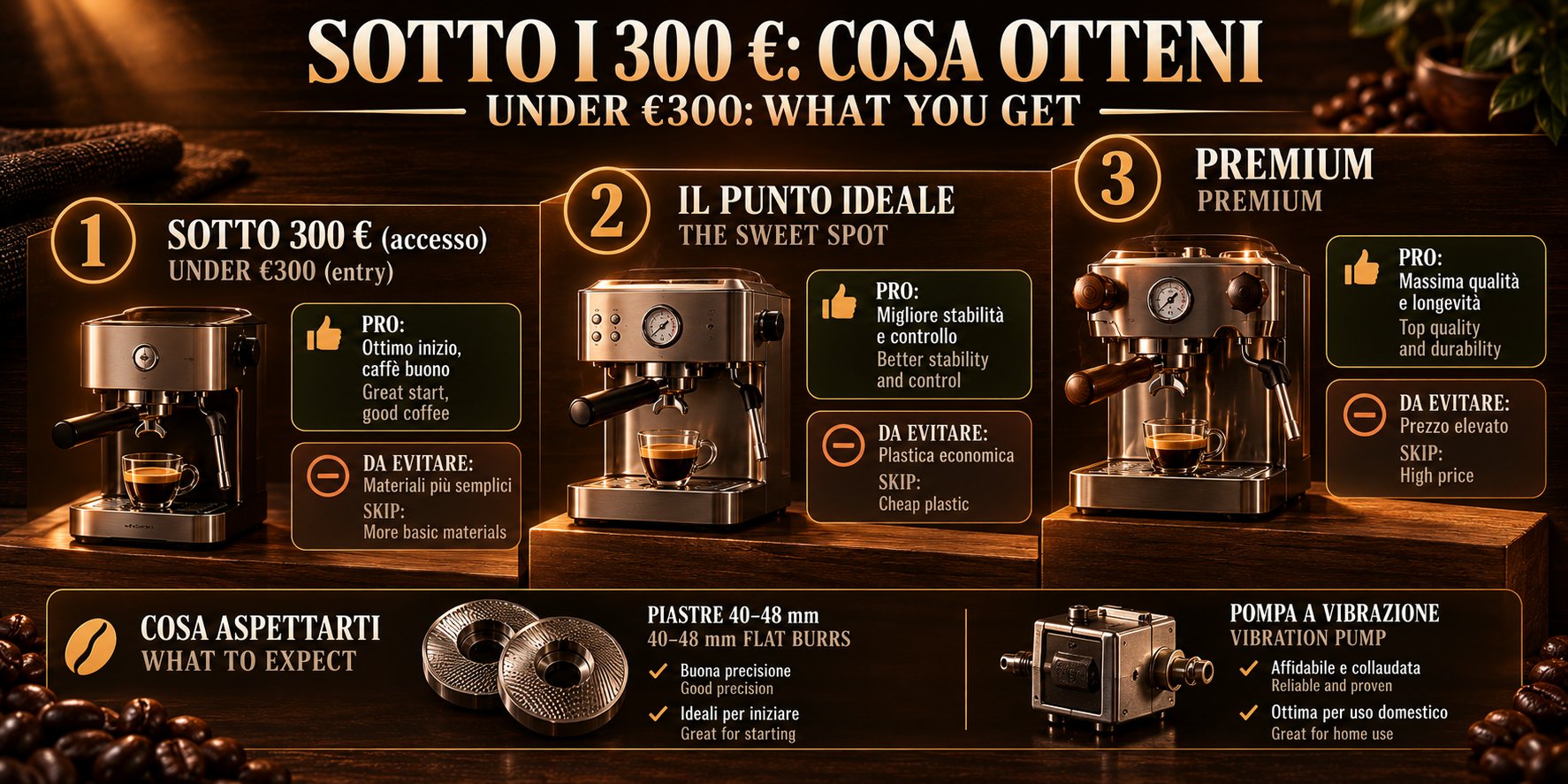
Table of contents
- The format that counts: a semiautomatic with a metal 58 mm group: the most repairable format, with the widest accessory market. Compact 51 mm machines (e.g. De’Longhi Dedica) or 54 mm ones work and cost less, but leave less headroom to grow: both options are listed below.
- The thermoblock heats water in 20–30 seconds: at home, with one or two cups a day, it is an acceptable compromise.
- A 300 euro machine with a 150 euro grinder beats a 500 euro machine without one.
The right espresso machine under 300 euros: what you actually get
In this range you buy on average a semiautomatic with a thermoblock, a vibration pump and a 54 or 58 mm group.
The thermoblock heats the water in 20–30 seconds and oscillates more than a boiler. But at home, with one or two cups a day, it is an acceptable compromise.
The coffee comes out drinkable, and the learning curve is the point, not the machine.
Spares — gaskets, basket screens, pump, portafilter — are available everywhere in Italy. That lowers the risk of a purchase at that price.
What you do not get is the thermal stability of the prosumer tier. Without a PID or a heat exchanger, the group temperature settles after the first shots of the day and can vary with use.
The practical consequence: the dial-in you do in the evening shifts by a degree in the morning. It is normal, not a fault.
You manage it with a slightly coarser grind and a measured dose, not with the machine.
Thermoblock: enough, with a caveat
The thermoblock is the standard heater in this range: it heats a metal block that carries the water under pressure.
The advantage is fast heat-up and low cost.
The caveat: with a single circuit, steam and extraction share the block. To steam milk after the espresso you wait or flush, and the group cools.
For someone who only makes espresso in the morning it is not a problem. For someone who makes a cappuccino for breakfast, the steam arrives a bit weaker than on a single boiler.
If your budget can just reach 300 euros, consider the step up to a single boiler with PID: the difference in stability is felt within the first month of use.
The quality jump does not require going all the way to 700 euros.
58, 54 or 51 mm: pros and cons of each size
The 58 mm is the professional group standard: the widest market of spares, accessories and universal portafilters, and the safest long-term bet.
Compact machines with 51 mm groups (e.g. De’Longhi Dedica EC685) or 54 mm (e.g. some Breville/Precision lines) are not "wrong machines": they cost less, heat up fast and take little space.
Their downsides are real but relative: less room to grow, fewer universal accessories, and plastic groups that are harder to repair.
So: if the budget allows, go for 58 mm (the Gaggia Classic Pro included). If budget is a hard constraint or space is minimal, a 51 mm paired with a decent grinder is an honest compromise: both options are listed below, with their limits stated.
| Feature | What to ask for | What to avoid |
|---|---|---|
| Group | 58 mm, metal | 54 mm, plastic group |
| Heating | Thermoblock or single boiler | “By feel” blocks with no valve |
| Steam | Continuous wand, even if weak | No steam (espresso only) |
| Portafilter | Included, 58 mm, by hand | Only plastic “one touch” portafilter |
| Spares | Gaskets and pump available in IT | No-brand models with no service network |
Features You Can Skip When Starting Out
- The 300 euro superautomatic: the internal grinder is the weak point, and an out-of-warranty repair costs more than the machine.
- The 54 mm format: same price, fewer spares, non-standard portafilter.
- Adjustable pressure as a first purchase: it is appreciated only once dose and grind are already consistent.
- A water tank over 1.5 litres: the coffee water is used within the following hour.
- “Bar” marketing: a professional label on a 300 euro machine changes neither physics nor components.
Our picks (selected from official specs)
| Product | Spec | For whom | |
|---|---|---|---|
| De’Longhi Dedica EC685 | Thermoblock, 51 mm | First machine on a real budget | View on Amazon |
| Gaggia Classic Pro | 58 mm brass group (not E61) | Just over 300: the real upgrade | View on Amazon |
| Tipre scale with timer | 0.1 g / 2 kg | Dose and time from day one | View on Amazon |
Choosing the espresso machine: the three-step method
- Decide the format: semiautomatic; at equal budget prefer 58 mm, but a good 51/54 mm can be the right call when price or space is the constraint (see the formats section above).
- Check the spares: if gaskets and basket screens are not available in Italy, discard it.
- Read the reviews on the steam, not the coffee: the steam is where models in this range really differ, and a wand that holds a cappuccino is worth half a machine.
Then buy the grinder — do not skip it — and start measuring: a 300 euro machine with a 150 euro grinder beats a 500 euro machine without one.
To see what changes stepping up while staying under 500 euros, see the guide to espresso machines under 500 euros.
In the coffee grinder for espresso section you find the grinder choice by budget, and in the home espresso machine section the complete guide to price ranges and dial-in.
Espresso machine features are documented in Wikipedia: Espresso machine.
Between €150 and €300: what actually changes
Verdict: between €150 and €300 you are not buying better coffee, you are buying stability and repairability. The first shot can taste similar, the hundred and twentieth will not.
Under €150 you get compact thermoblocks, 51 or 54 mm groups often in plastic, knobs in cheap material. They work, but there is almost no room to grow.
In the €200-300 band the physics change: metal 58 mm groups, larger boilers or exchangers, far less thermal drift between one shot and the next.
What to read in the spec sheet, in order: group diameter, group material, presence of a three-way valve, basket size, spare parts declared by the manufacturer.
The vibration pump is standard across this whole band, it is not the differentiator here. The differentiator is how long the machine holds temperature between the first and the second coffee.
Used under €300: what to check before paying
Verdict: a used machine makes sense only for known models with spare parts available. Everything else is a blind ticket.
Espresso machines age in two places: the group gasket and limescale in the boiler. Both are fixable faults, but both take work.
Before paying, ask three things: when was the last descaling, does the stream run straight or spray, is there play in the steam lever. A crooked stream tells you a lot about the shower screen.
A machine parked for two years with a hardened gasket is worth less than the price you see: budget 20-30 euros of parts and one hour of work.
A power-on demo does not replace real checks: ask for a photo of the group gasket and the water tank. White limescale around the diffuser is the most honest signal you will get.
Accessories to add in the first six months
Verdict: after the machine, the right second purchase is the tamper, the third is a scale. Everything else can wait.
The stock tamper almost never centres the group properly. A crooked tamp creates channels and a shot that turns bitter half way through the cup.
A kitchen scale is not enough under two grams: the first ten grams of dose move extraction more than the grind does. Get a coffee scale with 0.1 g resolution.
A group cleaning brush, detergent tablets and a knock container: cheap, and a dirty machine adds sourness and a musty note to the cup within weeks.
If you start from zero, the sensible order is: machine, dedicated grinder, tamper, scale. An aftermarket 58 mm portafilter only after you know what you dislike about the stock one.
Frequently asked questions
What’s the difference between a thermoblock and a boiler in a home espresso machine?
A thermoblock heats water in 20–30 seconds and keeps costs down, but with a single circuit steam and extraction affect each other and the temperature swings more.
A single boiler with PID costs more and gives more thermal stability: if you make cappuccinos often, the difference is noticeable.
Is a 300 euro espresso machine good enough for cappuccino?
With a thermoblock the steam comes out a bit weaker than on a single boiler, and between the espresso and the milk you often wait or flush the circuit.
If cappuccino is your daily breakfast, consider a single boiler with PID; if you only drink morning espresso, the thermoblock is enough.
Is a 300 euro machine with a grinder better than a 500 euro machine without one?
A 300 euro machine paired with a 150 euro grinder beats a 500 euro machine without one: without fresh, adjustable grinding the machine alone is not enough.
The grinder is what the coffee actually reacts to: a good grinder makes a measurable difference, so don’t leave it out of your budget.
Is a 51 mm group a problem on a machine under 300 euros?
No: 51 mm compacts (like the De’Longhi Dedica) cost less, heat up fast and take little space. The downsides are real but relative: less headroom to grow, fewer accessories and often plastic groups.
If the budget allows, go for 58 mm, the most repairable format with the most accessories.
Go deeper: milk frother guide.
More useful spares and accessories for this article
| Product | Feature | For whom | |
|---|---|---|---|
| 58 mm double-spout portafilter | With double basket | Starting 58 mm with no frills | View on Amazon |
| Gaggia MD15 | Conical burrs, compact | First electric grinder | View on Amazon |
| WECOOK Paola 1-cup | Aluminium, single serving | One cup, zero waste | View on Amazon |
| Severin electric milk frother | Hot and cold, stainless | Cappuccino without the steam wand | View on Amazon |
| Diyife scale with timer | 0.1 g / 2 kg, USB | Always the first purchase | View on Amazon |
| Borbone ESE pods Light 150 | Compostable, -50% caffeine | ESE without the sleepless night | View on Amazon |
| Flintronic TDS meter | Digital, ±2% | Measure your water first | View on Amazon |
| Set 12 porcelain cups | 80 ml, dishwasher safe | Espresso deserves proper cups | View on Amazon |
| Airtight jar 1.5 L | Steel, holds 650 g | The week's supply, sealed | View on Amazon |
As an Amazon Associate I earn from qualifying purchases. Note: some links on this site are affiliate links: if you buy through them, I may earn a commission at no extra cost to you. Affiliate links never influence my recommendations.