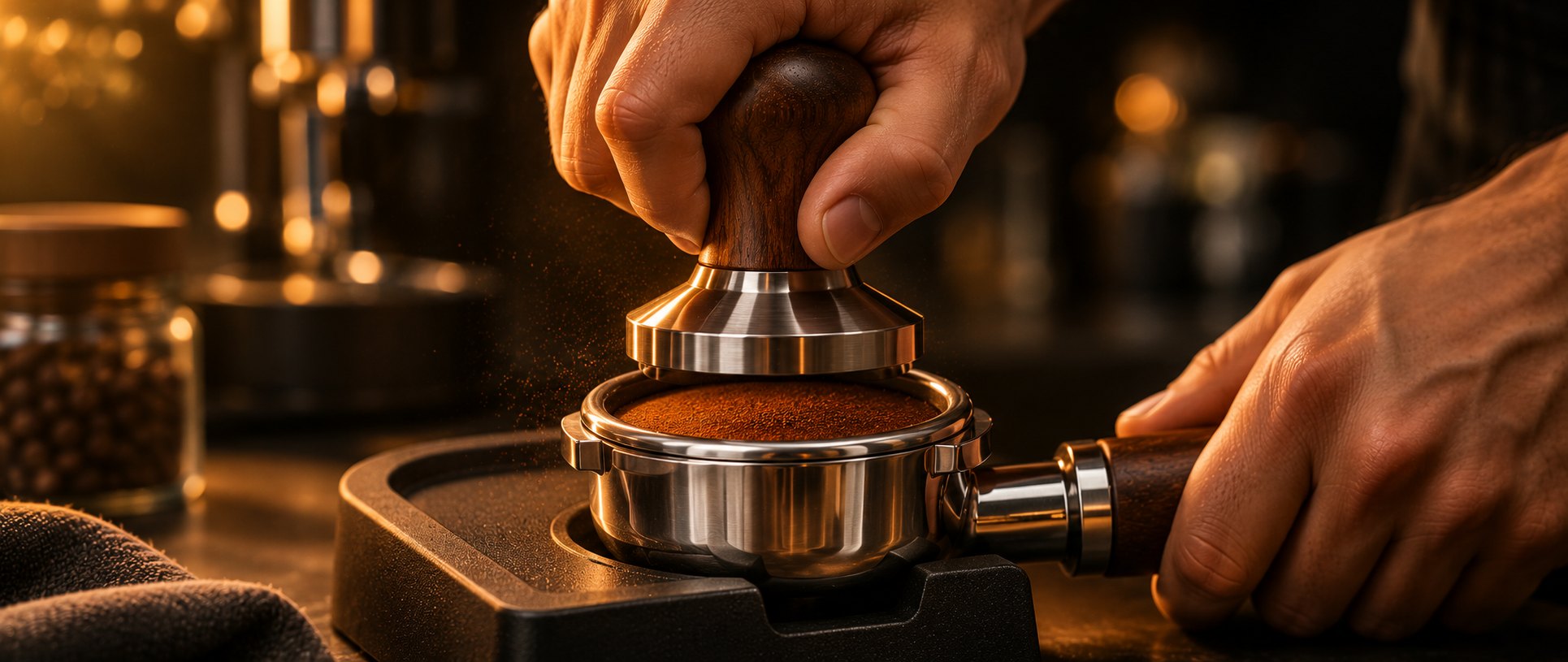
An expensive tamper won’t necessarily produce a better espresso. Whether you spend 30 € or 90 €, what matters most is a properly sized base and a level, consistent tamp. Applying more force isn’t usually the answer.
Table of contents
- Flat face, no grooves: the old ridged ones are superstition.
- Diameter = basket diameter (58.35 mm for standard 58 groups; 51 mm for compact De’Longhi).
- Weight counts for nothing: any comfortable 10-15 kg is plenty; consistency beats force.
- Dead flat and square is the only skill worth training: a 2° tilt = channeling.
- Distribute first, tamp second: the distribution builds the evenness; the tamp only preserves it.
The 15 kg myth (debunked with numbers)
Extraction research — most famously the World Coffee Research work popularised by Lance Hedrick — shows that past roughly 6-9 kg the bed compresses barely more: 9 bar of water does far more than your arm. The real difference comes from the grind, not from arm force. Hence the rule: press until the coffee stops moving down, then stop. Everything else changes very little.
Types: manual, spring, click torque
| Type | How it works | Pro | Con |
|---|---|---|---|
| Flat manual | You push, you feel | Cheap, zero maintenance | Angle and force are on you |
| Self-leveling | Spring centres and “clicks” at the end | Auto angle, repeatable | 20-60 €, spring ages |
| Click torque | Presses to X newton then slips | Barista-level repeatability | Overkill for home |
For home use the true value pick is a flat aluminium 58.35 mm tamper with a polished base (20-35 €). Self-leveling makes sense only if your tamps are still crooked after 100 shots: it fixes the angle, not the dose. Click torque only earns its money at dozens of coffees a day.
Size: the millimetre play that matters
A 58 mm tamper in a 58.4 mm basket leaves a rim of uncompressed coffee: that is where channeling is born. Typical sizes: 58.35 mm for most E61/Gaggia/Rancilio groups, 58.5 for some IMS baskets, 51 mm for compacts. If the tamper rattles in the basket it is too small — replace it. The right size costs less than a café latte; you pay for the wrong one in every cup.
The technique in 4 steps (the part that counts)
- Distribute before you tamp: a tap or a distribution tool; 90% of channeling comes from distribution, not from the tamp.
- Place and press straight: elbow at 90°, locked wrist, force along the axis. Do not twist — that final twist is another myth.
- Wipe the rim: grounds on the basket neck stop the group gasket sealing.
- Lock in and go: a tamped puck does not wait; the longer it sits, the more the bed settles on its own.
A bar trick to train squareness: tamp into a dosing ring on a plate, then sight it against light from two opposite sides — the reflection must look symmetric. Ten practice rounds and you will never come out crooked again. The 7 classic causes of a crooked shot are covered in our guide to espresso channeling.
Our tamper kit picks (selected from official specs)
| Product | Spec | For whom | |
|---|---|---|---|
| 58 mm constant-pressure tamper | Steel, spring release | Even pressure without thinking | View on Amazon |
| Tipre scale with timer | 0.1 g / 2 kg, flow rate | Dose and time in one tool | View on Amazon |
| MHW-3BOMBER puck screen | Double layer 0.8 mm | For the perfect bed | View on Amazon |
Pair it with the rest of the kit
The tamper works with the scale and the grinder: weigh the dose, build an even bed, press straight. If there is only one budget, spend it in this order: grinder > distribution > tamp. A tamper alone never fixes a bad grind.
Stop training force, start training angle. A flat, square, correctly sized tamp — with the right brewing method — beats any gadget, and gets you closer to what you actually want: crema that comes out straight, every time.
Go deeper: 58 mm portafilter, espresso machine under €300.
Why a Level Tamp Matters More Than Force
Verdict: level beats force. Two 8 kg presses leaning two degrees do more damage than a 5 kg press dead flat.
The reason is geometry: the coffee bed is a few millimetres tall and water takes the short road. Even with no visible tilt, a crooked tamp leaves one side denser, and the channel forms where resistance gives first.
How to check with no purchase: tamp, lay the basket on its side, and read the surface against a light. If light passes on one side, your wrist is not neutral.
The number worth chasing is repeatability, not the peak: same bed height for twenty days running. An incorrectly adjusted spring tamper can make the same mistake repeatedly; a manual one works only if your wrist makes it honestly level.
Diameter and clearance: the half millimetre that decides
Verdict: the gap between tamper edge and basket wall is where the channel is born. Tighter clearance, less coffee pasted to the wall above the bed.
A 58.35 mm tamper in a 58.5 mm basket keeps the wall cleaner than a 58.0. But go too tight and the tamper binds, especially with damp coffee: 58.35 is the sensible compromise, not the closest possible fit.
Flat versus convex base does not change bitterness; it changes the water left sitting on the puck after the press.
The internet has argued that for a decade without an extraction protocol settling it. When in doubt, take the base that leaves a glossy surface: compacted, not crushed.
Tampers You Probably Don’t Need
Verdict: a torque-calibrated tamper serves people who change recipes daily, not people who pull the same two shots. Buying one “to level up” usually buys a second object that does the same job.
Skip: exotic wood handles (porous, seasoned by coffee oils), tamper gadgets with kilogram displays, six-piece sets where five items are decoration.
Worth it, chosen well: steel body, lapped flat base, diameter centred on your basket, a weight that steadies your wrist. Three of those fit in 30-40 euros; the turned handle is luxury that never touches the cup.
Approfondimento esterno: voce enciclopedica sul caffè.
More useful spares and accessories for this article
| Product | Feature | For whom | |
|---|---|---|---|
| 58 mm double basket | Stainless steel, double | Serious spare when the old one clogs | View on Amazon |
| Gaggia Classic Pro | 58 mm brass group, parts everywhere | The buy-it-for-now upgrade | View on Amazon |
| Diyife scale with timer | 0.1 g / 2 kg, USB | Always the first purchase | View on Amazon |
| Borbone ESE pods Light 150 | Compostable, -50% caffeine | ESE without the sleepless night | View on Amazon |
| Gaggia MD15 | Conical burrs, compact | First electric grinder | View on Amazon |
| Mini milk jugs 2×100 ml | Ceramic, 100 ml | Serve milk and syrup in portions | View on Amazon |
| Flintronic TDS meter | Digital, ±2% | Measure your water first | View on Amazon |
| Set 12 porcelain cups | 80 ml, dishwasher safe | Espresso deserves proper cups | View on Amazon |
| Airtight jar 1.5 L | Steel, holds 650 g | The week's supply, sealed | View on Amazon |
As an Amazon Associate I earn from qualifying purchases. Note: some links on this site are affiliate links: if you buy through them, I may earn a commission at no extra cost to you. Affiliate links never influence my recommendations.