Choosing a home espresso machine means deciding how much control to keep in your hands and how much to spend. The two big families are semiautomatic and superautomatic, and within the semiautomatic, prices from 300 to 800 euros change little for the user and a lot for stability. Below is the method to navigate, with indicative price ranges.
- Semiautomatic to learn and experiment, superautomatic for convenience: one decision, not a detail.
- The budget rule: under 400 € a 58 mm thermoblock, 400–600 € a single boiler with PID, above 700 € an E61 group.
- No budget drops the grinder: 300–500 € for a flat-burr grinder remain necessary even on a 1000 € machine.
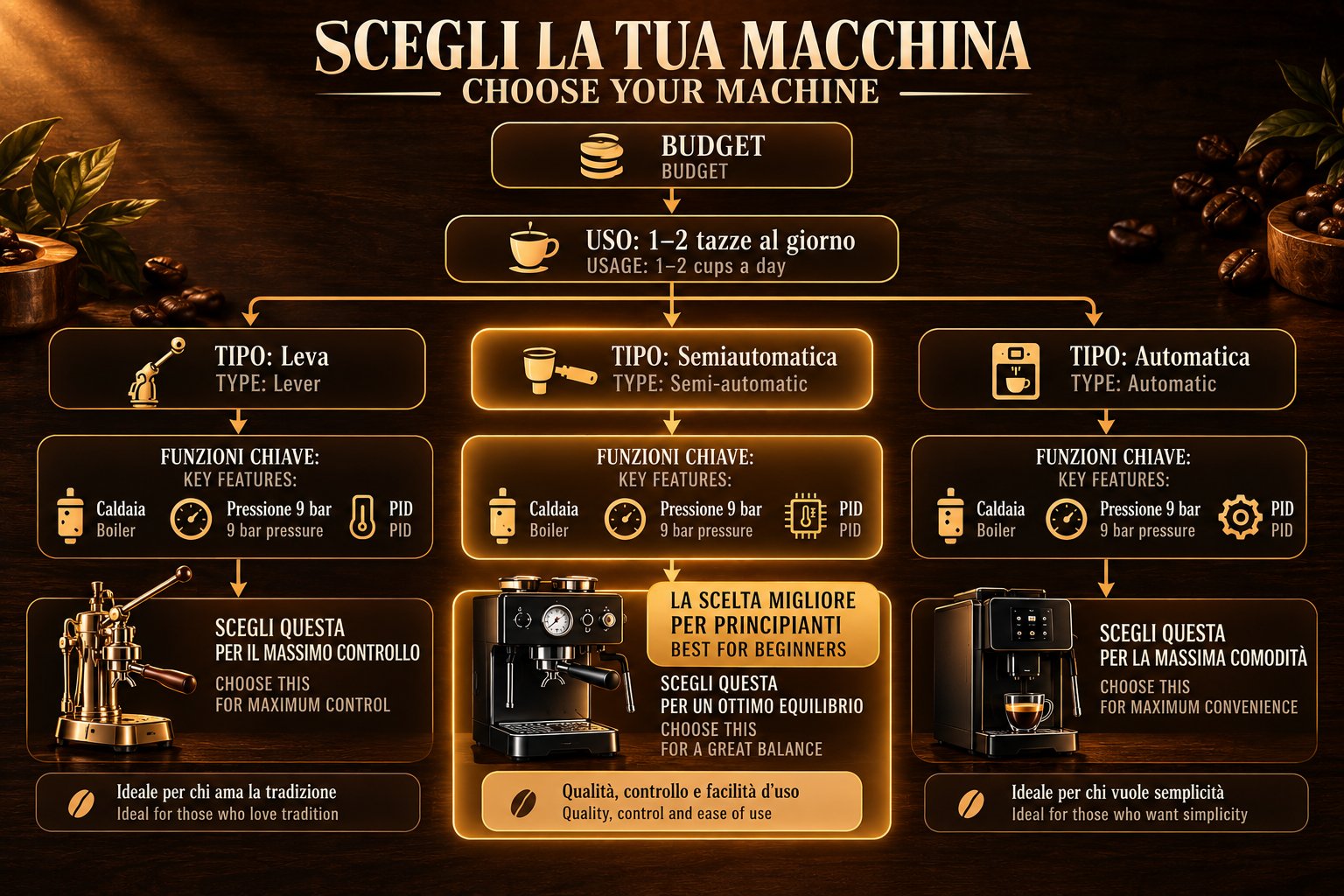
Home espresso machine: semiautomatic vs superautomatic
A semiautomatic machine heats the water and pumps at about 9 bar; grinding, dosing and tamping are on you. It is the format where the learning is the point: every mistake shows up in the extraction time and gets corrected.
Maintenance costs are low and spares — gaskets, basket screens, pumps — are available everywhere, with a dense service network, especially in Italy. At equal price, a semiautomatic also holds a learning curve you can taste, week after week.
A superautomatic machine builds in a grinder and doses the whole bean on its own: you press a button and the cup comes out. It is the right choice for daily convenience without technique, one or two drinks a day.
The limits are three. The price, on average from 500 to over 4000 euros depending on the model. The internal grinders, in general less consistent than a dedicated external grinder. And repairs: being almost all electronics, the cost of a service visit out of warranty weighs on the purchase price.
A superautomatic is best seen as a home appliance, not as a machine for learning.
In one line: want to learn and experiment, choose the semiautomatic; want a good coffee in a minute, choose the superautomatic.
The classification and technique of espresso machines are documented in Wikipedia: Espresso machine.
By budget: 300 / 500 / 800 €
| Range | What you get on average | Typical tech | Limits |
|---|---|---|---|
| 300–400 € | First real machine, one or two cups a day | Vibration pump, thermoblock, 54 or 58 mm, continuous steam | Limited thermal stability, no backflush on standard-portafilter models |
| 400–600 € | Perceptible quality jump | Upgraded thermoblock or single boiler, PID, 58 mm | Single boiler: wait between espresso and steam |
| 700–1000 € | Prosumer tier | Copper E61 group or heat exchanger, PID, more controlled flow | Bigger footprint and weight |
Around 800 euros — and in any case under 1000 — you enter E61 territory, new or well-kept used: that is the point where the machine stops heating by feel and keeps group temperature stable from one shot to the next, removing the most annoying variable of dial-in.
Two notes. First, the prices are indicative and vary by model and by offer: the used market brings E61s to roughly half of the new price.
Second, at none of these budgets is the grinder included: the 300–500 euros for a flat-burr grinder remain necessary even on a 1000 euro machine, and the choice is a guide of its own in the tools section.
Group, pump and pressure
The pump produces the raw pressure — 15–23 bar on vibration, 20–25 on membrane — but the pressure at the cup is about 9 bar in both cases: that is the working value of espresso. The difference between pumps is footprint and price, not force.
The opposite is true for temperature: it is the variable that decides whether a group is worth it. Above that, pressure is modulated by hand on lever machines, a separate chapter.
The four heating systems, from cheapest to most stable:
- Thermoblock: heats in 20–30 seconds, swings more.
- Single boiler: stable for espresso, but steam cools the group: you wait or flush.
- Heat exchanger: large boiler with a serpentine circuit, espresso and steam almost simultaneously.
- Dual boiler: separate circuits for extraction and steam, the stability reference, at higher price and footprint.
At home, under 1000 euros, the best compromises remain a single boiler with a PID and an E61.
Adjustable pressure and pressure profiles exist and work, but they are an add-on for whoever dials in constantly: they do not turn an average machine into an excellent one.
What you do NOT need at home
- Commercial two-group machines: the space, power and drainage of a venue, with two groups of which you use one.
- Adjustable pressure and flow as a first purchase: they cost, and they are only appreciated once dose and grind are already consistent.
- The 54 mm format if the budget allows it: 58 mm is the standard, costs the same in the same tier, and has more widely available spares.
- Reservoirs over 2 litres: the water for coffee is used within the next hour, a cistern is not needed.
- The bar marketing: the professional label on a 300 euro machine changes neither physics nor components.
- Two machines, one for espresso and one for milk: a single well-chosen machine covers both uses; steam matters more than the number of groups.
In short: up to 400 euros, a 58 mm thermoblock with a vibration pump; 400–600, a single boiler with a PID; above 700, an E61. Then buy the grinder and start measuring. The guides section continues the series: water, maintenance and accessories.
Note: Some links on this site are affiliate links: if you buy through them we may earn a commission at no extra cost to you. Affiliate links are marked and never influence our recommendations.