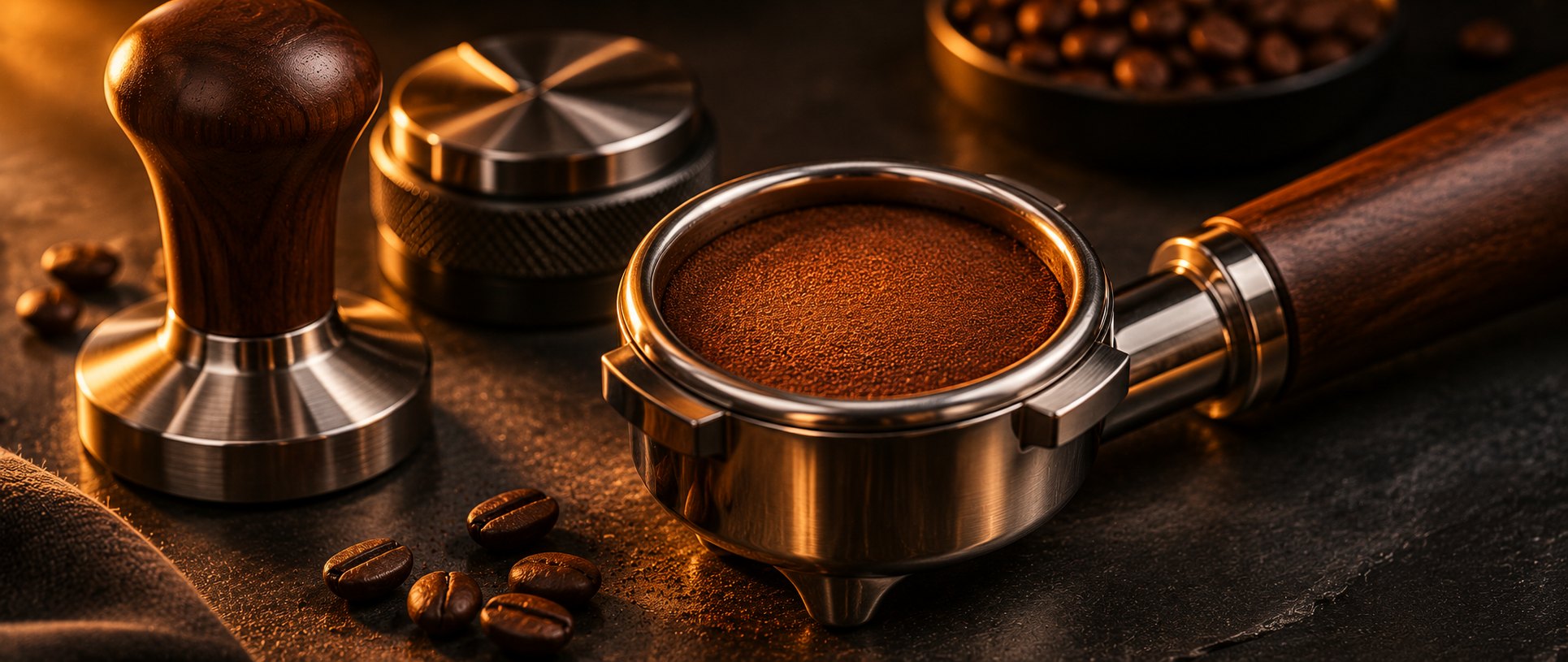
A poorly matched portafilter or basket can lead to messy, uneven extractions. If your machine uses a 58 mm group — as many Gaggia, Lelit, Rancilio and ECM models do — you’ll need to understand the difference between pressurized and non-pressurized baskets.
Table of contents
- Measure the group diameter: 58 mm is the quality standard, 51 mm is economy (small De’Longhi/Breville).
- Freshly ground coffee plus a grinder → non-pressurized (single wall) basket.
- Supermarket pre-ground or pods only → pressurized (double-wall) basket: it fakes crema even with a bad grind.
- Mind the terms: pressurized vs non-pressurized is a property of the basket; bottomless is the portafilter body without spouts — a separate choice that pairs with regular or non-pressurized baskets.
- The bottomless portafilter is a diagnostic: it exposes channeling and uneven prep in 3 seconds.
- Golden rule: the basket follows the grinder, never the other way round.
58 mm vs 51 mm: why it changes everything
The number is the group/basket diameter in millimetres. 58 mm is the professional-group standard: more extraction area and, in typical double usage, baskets of roughly 14-20 g depending on the model — the dose depends on the basket, not on the diameter itself. The 51 mm entry machines use smaller baskets (often 7-9 g) that forgive dosing mistakes less: not a universal rule, check your machine’s stated basket capacities. If your machine is 58 mm you are already in the right class; machine specs and measurements are in the equipment section.
| Diameter | Typical dose | Who uses it | Spare parts |
|---|---|---|---|
| 58 mm | 18-20 g | Gaggia, Lelit, Rancilio, ECM | Huge, incl. aftermarket |
| 54 mm | 15-17 g | Higher-end Breville | Limited, brand-specific |
| 51 mm | 7-9 g | Entry De’Longhi, 99 € machines | Often OEM only |
Baskets and portafilters: the table that settles it
On a 58 mm group the baskets come in two families (non-pressurized and pressurized); the bottomless is a separate thing — a spoutless portafilter body. You choose with one question: do you grind, or buy pre-ground?
| Type | How it works | For whom | Downside |
|---|---|---|---|
| Non-pressurized basket (single wall) | Perforated bottom (often many fine holes): extraction comes from the coffee, not from the filter | People who grind fresh and dial in | Forgives nothing: bad prep shows |
| Bottomless portafilter — not a basket: the body without spouts, to pair with a basket | The stream falls straight: channeling shows immediately | Diagnosing dial-in mistakes | Messy if prep is rough |
| Pressurized | One tiny hole builds back-pressure, fakes crema | Pre-ground, absolute beginners | Artificial crema, less body |
The paradox: the pressurized basket looks like the beginner’s choice but stays wrong the moment you buy a grinder. With fresh coffee a single-wall basket gives a more aromatic cup than the same machine pressurized. If you are coming from a 51 mm pressurized machine, The lever vs semi-automatic guide explains what really changes when you step up.
Handle: wood, plastic or steel (and the front plate)
The handle screws on and swaps in 20 seconds, but the thread is not universal: it varies by brand and model, check compatibility before ordering. Plastic: cheap, stays cool, serviceable default. Wood: better grip, classic bar look, needs drying after washing. Steel: hygienic and indestructible, runs hotter. Check two things before ordering: length (the shot must clear the drip tray arm) and the front plate: on some Gaggia the front collar must be swapped for the long version to fit a bottomless.
What to actually buy, in order
If your 58 mm machine came with a pressurized basket, the best value upgrade is a quality single-wall basket (IMS and similar, from ~15 €): precision drilling and deburring improve flow uniformity versus low-end OEM filters. Then a bottomless for diagnosis, not as a default. The tamper has a dedicated guide coming soon to this site.
See 58 mm portafilters on Amazon →
What we buy: portafilter and baskets (selected from official specs)
| Product | Spec | For whom | |
|---|---|---|---|
| 58 mm double-spout portafilter | With double basket | Starting 58 mm with no frills | View on Amazon |
| IMS Big Bang basket 14-16 g | Precision drilling | The upgrade you taste most | View on Amazon |
| 58 mm 2-cup stainless basket | Stainless steel | Serious spare part for Gaggia & co. | View on Amazon |
| MHW-3BOMBER puck screen | Double layer 0.8 mm | Even bed, minimal mess | View on Amazon |
Care: 2 minutes a day
- Rinse with water after every shot; check the group gasket weekly with a finger — it lasts 6-12 months, costs 5 €.
- Two-way disc: brush it dry; wet coffee left in the drawer stinks within an hour.
- No soap, ever: coffee absorbs grease and detergent like a sponge. A monthly soak in dedicated powder (Cafiza) is enough.
A better portafilter cannot make bad coffee good, but it gets more out of good coffee. With a serious basket and clean prep, the same Gaggia from three years ago starts to make sense — the rest is the brewing method and the right accessories.
Go deeper: espresso machine under €300, tamper guide, espresso machine for home.
Reading a bottomless portafilter: every squirt is a symptom
Verdict: the bottomless is a diagnostic tool. It turns a faulty extraction into a visible pattern within the first three seconds, which spouts hide entirely.
Dark, central flow — two or three streams merging slowly, no spraying — means an even bed, correct distribution, nothing to fix.
A single dark jet drilling the middle: most of the water is already running through one channel. The most likely cause is unbroken clumps, so the fix is distribution work, not a new grind.
Blond liquid gushing fast from many points: grind too coarse or a badly compacted bed. Check the dose-to-yield ratio first, then the tamp.
Squirting toward the rim, outside the holes: grounds trapped on the basket edge or a dose too low. The bed cannot seal against the wall, and water escapes through that gap.
A practical note: the first two seconds are messy even on a perfect shot. Judge from the third second onward, not from the first drop.
Bottomless versus spouts: same faults, two views
Verdict: spouts show where a fault lands; the bottomless shows where it starts. Use the bottomless to diagnose and spouts to serve; the flow does not change, the information does.
- One spout far heavier than the other: uneven distribution in the basket, invisible until you look underneath.
- Spouts that drip late and hesitant: grind too fine or bed too high, a choke signal.
- A single jet on the bottomless where spouts looked normal: the fault was there, only masked.
- Lighter crema through spouts: normal, spouts agitate more; it is not a quality indicator.
Baskets and distributors: what matters and what is myth
Verdict: basket quality lives in hole straightness and deburring, not hole count. And a distributor levels the surface — it cannot break clumps two centimetres below.
The hole-count myth: flow responds to hole diameter and total open area, not to counting holes. Two baskets with different counts can behave identically.
Thin walls do not mean a better basket: single-wall versus double-wall is about pressurization, not quality. Precision baskets stay single-wall, as the tamper guide covers.
The paddle distributor has one honest use: flattening a bed the grinder already left loose. If clumps sit under the surface, it just evens out the surface.
Quick diagnosis: if shots still spray on the bottomless with a distributor, the problem is underneath. WDT reaches where the paddle cannot, and the symptom-by-symptom fixes start there too.
Approfondimento esterno: voce enciclopedica sul caffè.
More useful spares and accessories for this article
| Product | Feature | For whom | |
|---|---|---|---|
| Gaggia Classic Pro | 58 mm brass group, parts everywhere | The buy-it-for-now upgrade | View on Amazon |
| WECOOK Paola 1-cup | Aluminium, single serving | One cup, zero waste | View on Amazon |
| Diyife scale with timer | 0.1 g / 2 kg, USB | Always the first purchase | View on Amazon |
| Gaggia MD15 | Conical burrs, compact | First electric grinder | View on Amazon |
| Mini milk jugs 2×100 ml | Ceramic, 100 ml | Serve milk and syrup in portions | View on Amazon |
| Borbone ESE pods Light 150 | Compostable, -50% caffeine | ESE without the sleepless night | View on Amazon |
| Lavatelli coffee doser | Container + dosing spoon | The right scoop, every time | View on Amazon |
| Set 12 porcelain cups | 80 ml, dishwasher safe | Espresso deserves proper cups | View on Amazon |
As an Amazon Associate I earn from qualifying purchases. Note: some links on this site are affiliate links: if you buy through them, I may earn a commission at no extra cost to you. Affiliate links never influence my recommendations.