Dialing in means adjusting grind size, dose and extraction time until your espresso tastes balanced. Many bitter, sour or slow shots can be traced to a handful of common mistakes.
Below are the most common dial-in mistakes — from handling grind and dose to using the cup and pressure correctly — and, above all, how to avoid them, with a diagnosis table: symptoms, likely causes, and the first correction to try.
The reference parameters (18–20 g dose, 36–40 g output, 25–30 s) are the standard ones described in our guide. Reference parameters for dial-in are standardized by the Specialty Coffee Association.
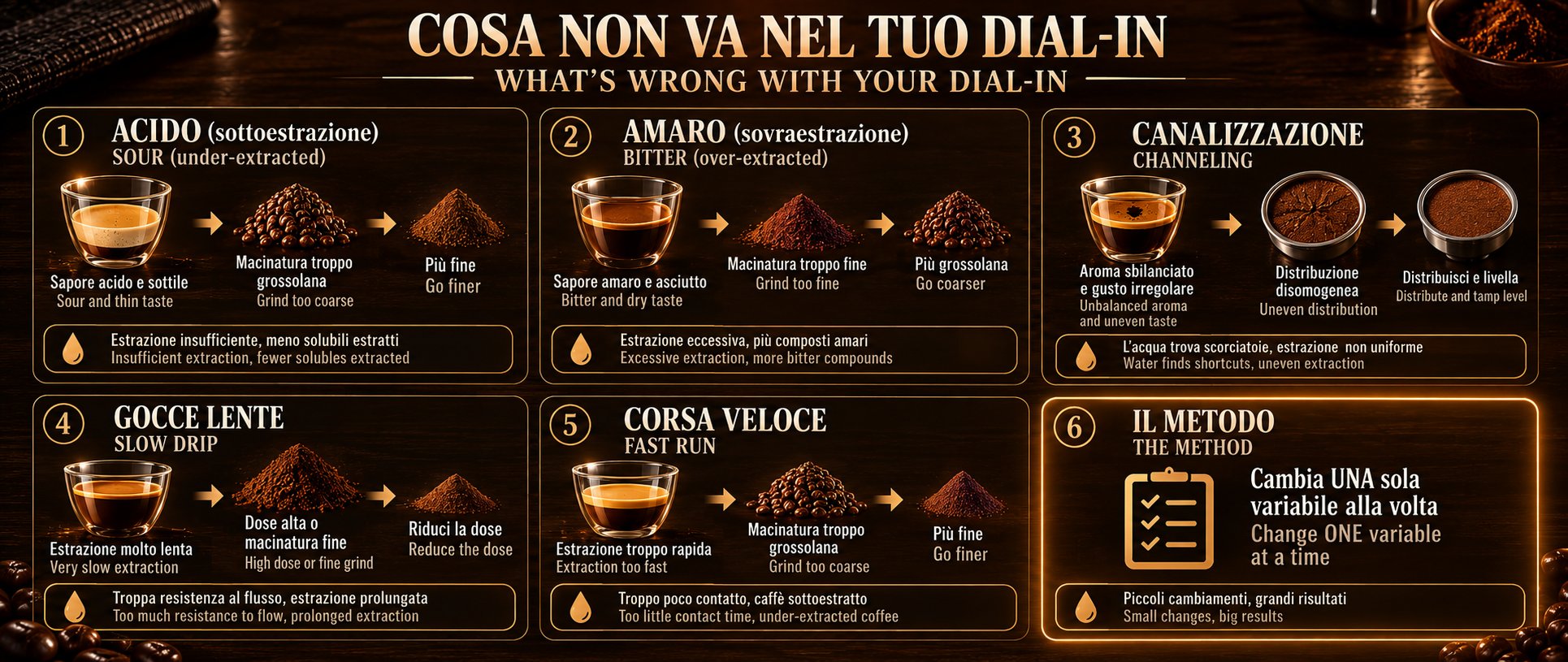
Table of contents
- Change one variable at a time: the grind first, the dose only after. Otherwise it becomes impossible to tell what caused the result.
- Always weigh dose and output — 18–20 g in, 36–40 g out, 1:2 ratio — on a 0.1 g scale. Time is an effect, not a cause.
- Bitter? Coarser. Sour? Finer. Choked? Distribution. The diagnosis table connects each cup symptom to the first correction to try.
Dial-in mistakes: grind and dose
The most frequent error: changing more than one variable at a time
The most frequent error is changing more than one variable at a time: you adjust the grind and, in the same session, the dose and the pre-infusion, and it becomes impossible to tell what caused the result.
The established rule is simple: change the grind, which is the main variable, test it, and only then touch the dose.
The dose should always be weighed with a 0.1 g scale: on average 18–20 g of coffee for a 36–40 g output, a 1:2 ratio.
Dosing by eye is like cooking without a scale: the same dosing cup filled “by sight” can vary by 1–2 g from one shot to the next, and that difference moves the extraction more than most people expect.
Second error: treating the grind setting as fixed
The right grind is always relative to humidity, coffee freshness, lot, and portafilter type. A fresher coffee, with more carbon dioxide and more moisture, often calls for a slightly coarser grind.
A coffee that has already released part of its CO2 may need a finer setting. Before any dial-in session, the practice is to pull two or three test shots and start from your previous setting as a reference, not from scratch.
Third area: the distribution of grounds in the portafilter
An uneven bed of coffee creates channels: water takes the path of least resistance, the extraction is partial and inconsistent, sometimes choking halfway through the shot.
The standard fix is to distribute the grounds with a WDT tool before tamping and to level the bed.
Tamp force matters far less than flatness: on average 10–20 kg is enough; what matters is a uniform, compact bed with no voids.
Cup and pressure: the mistakes you can measure but not taste
Measuring without instruments
The second group of mistakes concerns measurement. Judging an espresso only by the crema color or the time on the display, without weighing the output, is like navigating without instruments: time is an effect, not a cause.
The minimum tool is a scale under the cup that records dose and output. Without it, the output is never weighed, and the dose/output ratio, the real indicator of balance, stays unknown.
Pressure: two clarifications
First: home pumps are rated at 9 bar nominal, and in most cases there is nothing to adjust. Pressure is not the dial-in knob — grind size is.
If your machine allows it and you want to go further, a portafilter pressure gauge, on average 10–30 €, lets you verify the real pressure curve, which on many models starts lower and ramps up gradually.
Second clarification: temperature. If the machine has not reached thermal stability, every shot comes out different. The practice is to let the machine warm up and pull one or two waste cycles before judging anything.
Using the wrong basket for the dose
Last mistake in this section: an 18–20 g dose belongs in an 18–20 g basket. Forcing more in, or using less, changes the bed density and the flow time.
The single/double pairing matters too: a recipe built on a double, replicated on a single by changing the dose but not the grind, gives different results and needs re-dialing.
Quick diagnosis: extraction time as a compass
With an 18–20 g dose and a 1:2 ratio, time is the fastest compass. It is not the final judgement (that is the taste), but it tells you in five seconds which way to turn the grind.
| Time (18–20 g → 36–40 g) | What it means | First move |
|---|---|---|
| Under 20 s | Under-extraction: too coarse | Finer grind |
| 20–25 s | Borderline, often sour | One step finer |
| 25–30 s | Target zone | Listen to the cup: refine here |
| 30–35 s | Borderline, bitterness starts | One step coarser |
| Over 35 s | Over-extraction: too fine | Coarser grind |
Golden rule: turn one step at a time and redo two or three test cups. Two extractions, one at 24 s and one at 31 s, can both be good if the balance is in the cup: taste is the final judge.
Diagnosis: from bitter, sour, and choked to the first correction
Once dose and output are weighed, diagnosis becomes a procedure. Time should be read as a guide, not a target: with an 18–20 g dose, a 36–40 g output in 25–30 s is the standard reference.
But two 1:2 shots, one at 24 s and one at 31 s, can both be good if the cup is balanced. Taste is the final judge; the table below connects cup symptoms to the most likely causes and the first correction to try.
| Cup symptom | Likely cause | Correction |
|---|---|---|
| Bitter, dry, astringent; time over 35 s | Over-extraction: grind too fine | Coarser grind, one notch at a time |
| Sour, thin, sharp; time under 20 s, low output | Under-extraction: grind too coarse | Finer grind |
| Irregular flow, choked, dribbling | Channeling: poor distribution, stale coffee, static charge, dirty basket | Distribute with WDT, fresher coffee, clean basket and group |
| Dark crema but fast, bitter shot | Partial channeling | Distribution and circuit cleaning |
| Sharp throughout, low sweetness | Water too soft or extraction temperature too low | Check water and machine thermal stability |
On choking specifically, one note: in most cases it is not a machine fault, but a channeling or bed problem.
Before suspecting the pump or the valves, clean the basket, check that the group’s shower screen is not clogged, and re-dose while distributing the grounds with the WDT tool.
Only after ruling these causes out do you move on to the machine.
If the problem persists at equal dose, time, and ratio, work through the standard hierarchy: distribution first, then water, then the machine.
When in doubt, move the grind one notch at a time, always pull two or three shots, and compare them with the previous one: with this method, dial-in becomes a repeatable procedure that takes 15–20 minutes.
In short: one variable at a time, dose and output always weighed, grind size as the main lever, and time as a guide rather than a goal.
They are small habits, but they remove the vast majority of defective shots.
For scales, portafilter gauges, and WDT tools, see the tools section.
Updated: 26-10-2026
The dial-in tools (selected from official specs)
| Product | Feature | Best for | |
|---|---|---|---|
| Tipre scale with timer | 0.1 g, timer and flow rate | The one tool that measures all three numbers | View on Amazon |
| MHW-3BOMBER puck screen | Double layer stainless steel | Less channelling on stubborn shots | View on Amazon |
| 58 mm tamper | Steel, constant pressure | A flat, square tamp every time | View on Amazon |
Go deeper: dial-in from scratch, how to make great espresso, water for espresso, cost of espresso at home.
Why the right grind changes from one day to the next
Verdict: yesterday’s perfect setting can be wrong today even though nothing was touched. Green coffee trades moisture with the air and keeps releasing CO2: two processes that shift flow day by day.
Coffee beans are hygroscopic: an opened bag absorbs vapor and gains weight. Wetter grounds produce more fines and more clumps, and extraction quietly drifts along with them.
Before rewriting your theory, log three data points: days from roast, days since opening, and the weather of the last 24 hours. A humid week often asks for a different setting than a dry one.
Correct in small steps, roughly a quarter turn, and wait a couple of grinding cycles for the new position to settle. A collar reading taken immediately after adjusting is almost always off.
Puck prep: WDT before or after dosing?
Verdict: dose first, then WDT. Clumps form the moment grounds land in the basket, so the needles have to work exactly where the clumps land.
Stirring inside the dosing cup is useless: as the bed rises into the basket it re-clumps through static. The tool does its job on settled grounds, breaking clumps where they will stay.
After the WDT, let the bed settle with one light tap on the handle, then tamp flat and level. Why level beats force is covered in the tamper guide on this site.
Skip the double tamp. Every extra press cracks a bed that has already settled, and those micro-cracks are channels waiting to happen. One clean move, then hands off.
What the cup is telling you: sour, bitter, hollow
Verdict: sourness means extraction stopped too early, dry bitterness means it went too far, and a watery middle means a channel carved through the weakest point of the bed.
The extraction order makes the cup readable: soluble acids pass first, then sugars and caramelized compounds, finally the heavier bitter fractions. A short extraction simply never reaches the sweet part.
The physiology is simple: acidity and saltiness register immediately, while lingering bitterness arrives late and stays. If the bitter note shows up after a few seconds and refuses to leave, the shot ran long.
A hollow middle is a different family of problem: not weak coffee, but water crossing only one band of grounds. Uneven edges pulling away from the basket wall are a frequent culprit, not the grind.
And one case where no dial-in helps: a bag months past roast has lost aroma and CO2, so the cup stays flat at any setting. When every correction lands on the same flat result, suspect the coffee first.
More useful spares and accessories for this article
| Product | Feature | For whom | |
|---|---|---|---|
| Diyife scale with timer | 0.1 g / 2 kg, USB | Always the first purchase | View on Amazon |
| 58 mm double basket | Stainless steel, double | Serious spare when the old one clogs | View on Amazon |
| WECOOK Paola 1-cup | Aluminium, single serving | One cup, zero waste | View on Amazon |
| Gaggia Classic Pro | 58 mm brass group, parts everywhere | The buy-it-for-now upgrade | View on Amazon |
| Borbone ESE pods Light 150 | Compostable, -50% caffeine | ESE without the sleepless night | View on Amazon |
| Gaggia MD15 | Conical burrs, compact | First electric grinder | View on Amazon |
| Flintronic TDS meter | Digital, ±2% | Measure your water first | View on Amazon |
| Set 12 porcelain cups | 80 ml, dishwasher safe | Espresso deserves proper cups | View on Amazon |
| Airtight jar 1.5 L | Steel, holds 650 g | The week's supply, sealed | View on Amazon |
As an Amazon Associate I earn from qualifying purchases. Note: some links on this site are affiliate links: if you buy through them, I may earn a commission at no extra cost to you. Affiliate links never influence my recommendations.