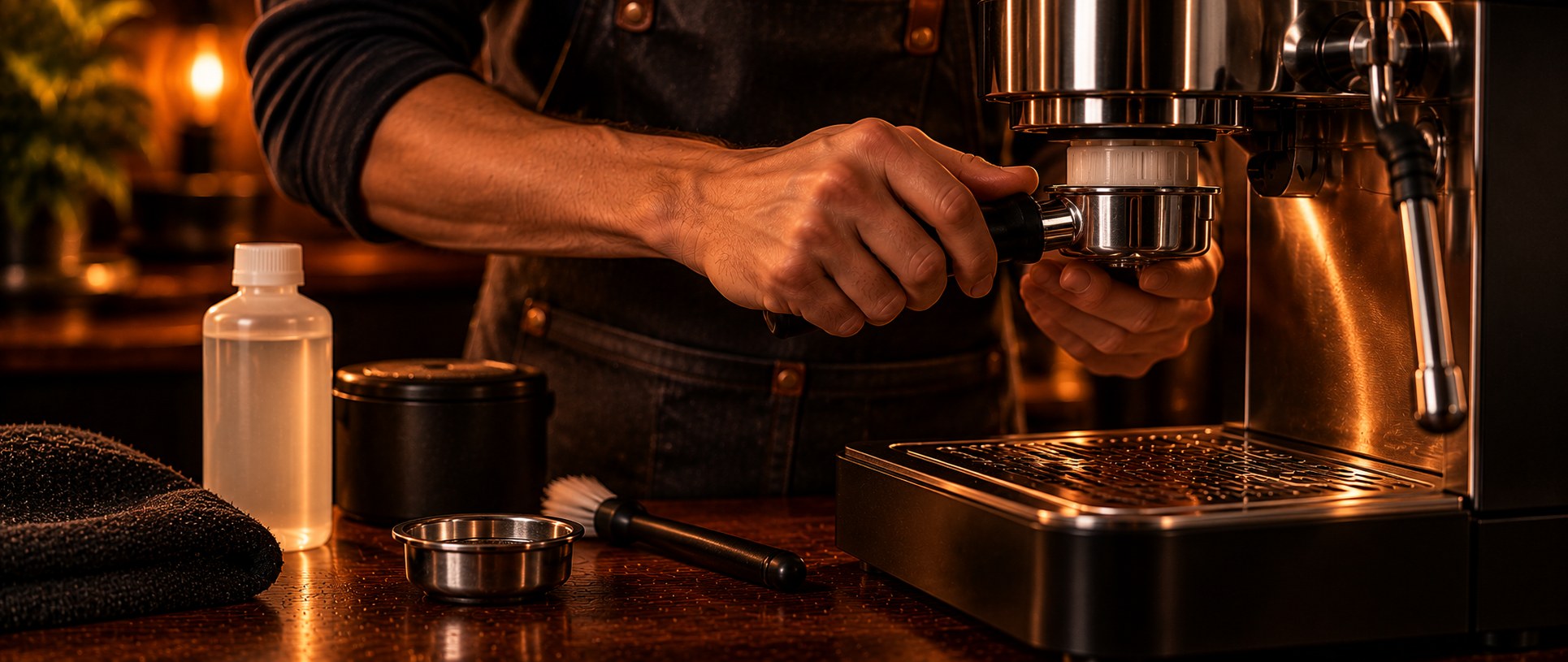
Espresso machine maintenance is the difference between a machine that lasts a decade and one that starts giving trouble after two or three years. The good news: the routine is short and most of the work can be done at home.
5–10 minutes a day, plus a monthly degreasing and one or two descaling sessions a year. This complete guide covers what to do every day, how often to degrease and descale based on your water hardness, and which symptoms mean it is time to call a technician.
Espresso machine components and maintenance are illustrated in Wikipedia: Espresso machine.
- Every day: 5–10 minutes — knock the puck, rinse and brush the portafilter, 1–2 water-only backflush cycles, clean steam wand.
- Once a month: degreasing soak for baskets and portafilter, 15–30 minutes. Descale every 3–6 months, depending on water hardness.
- Leaks, missing pressure, weak steam, strange noises? Call a technician: half-finished DIY repairs almost always make the fault worse.
Espresso machine maintenance: daily cleaning in 5 steps
The daily routine is done right after each use. It takes five short steps:
- Knock the wet puck out of the portafilter (into a bin or a knock box) and never leave used grounds sitting in the portafilter.
- Rinse the portafilter under running water and brush it with a dedicated brush: the leftover grounds contain oils that turn rancid as they oxidize.
- Run 1–2 cycles of water-only backflush, if your machine has a three-way solenoid and a blind basket; once a week add a dose of backflush detergent (on average a level teaspoon per cycle, per the product’s instructions).
- Wipe the group spout and the steam wand with a damp cloth, and before steaming milk open the steam for 2–3 seconds to clear the condensed water.
- Refill the tank with fresh water — filtered is better — and leave the machine on standby or off, according to the model’s instructions.
Two clarifications on backflush
Water-only backflush only makes sense on machines with a three-way solenoid; on many entry-level thermoblock machines without a return, group cleaning is reduced to brushing the basket and rinsing, and backflush detergent is not used.
Machines with an E61 group or a boiler, by contrast, get the most benefit from regular backflushing.
And on detergents
For cleaning, use only coffee-specific detergents: dish soap leaves residues that end up in your espresso and, over time, can damage the rubber gaskets.
Degreasing and descaling: the right intervals for your water
Degreasing: once a month
Degreasing removes the coffee oils that build up on baskets, portafilter, and group, which turn rancid as they oxidize.
The reference frequency is once a month: soak baskets and portafilter in hot water with a coffee-specific detergent (or a weak bicarbonate solution) for 15–30 minutes, rinse thoroughly, and wipe the group with a damp cloth.
If the machine sees light use, two or three shots a week, stretch the interval to 6–8 weeks.
Descaling: the frequency depends on your hardness
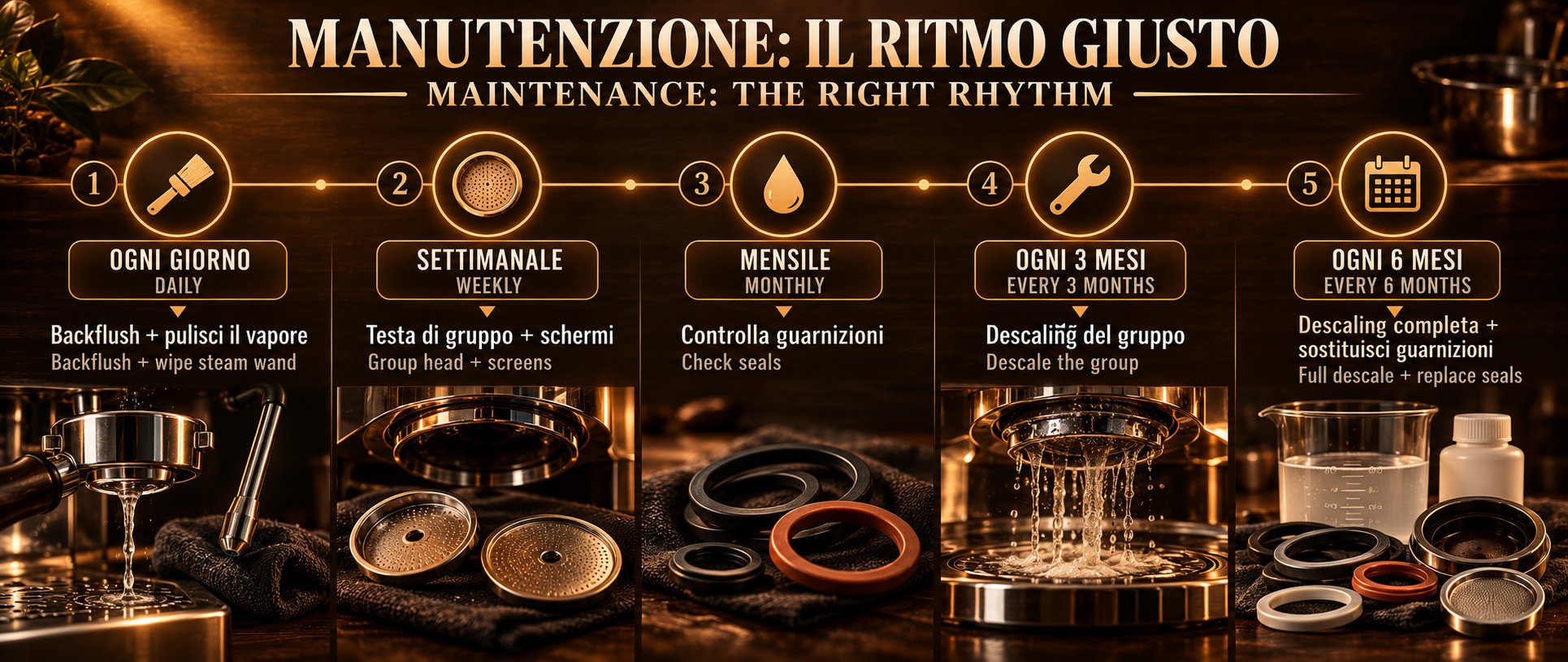
Descaling removes limescale from the boiler, group, and valves. Frequency depends on water hardness: with hard water, over 100 ppm CaCO3, on average every 3 months; with soft or re-mineralized water, 50–75 ppm, every 6 months.
Use a dedicated descaler (citric acid or commercial formulations) at the dose stated on the package, following the machine’s manual: procedures differ, and on some models only the circuit is descaled, not the group.
Avoid vinegar: it is corrosive to gaskets and metals and leaves residues. After every descale, run two or three cycles of clean water and check the taste of the first shots.
Gaskets: the 6–12 month check
Every 6–12 months it is worth checking the gaskets: the group gasket (the E61 gasket or the equivalent, depending on the model), the sleeve, and the steam O-rings.
Lubricate them with food-grade silicone grease and replace them when they are dry, cracked, or deformed; a gasket costs on average 5–15 € and on models with an accessible group the replacement can be done at home with a spare parts kit.
Visible scale in the tank or on the gaskets is the most reliable sign that descaling is overdue.
| Task | Indicative frequency |
|---|---|
| Portafilter rinse, basket brushing | Daily |
| Water-only backflush | Daily (with a three-way solenoid) |
| Backflush with detergent | Once a week |
| Degreasing soak of baskets and portafilter | Once a month (6–8 weeks if light use) |
| Descaling | Every 3–6 months, depending on hardness |
| Gasket inspection and lubrication | Every 6–12 months |
When to call a technician (and why a half-finished repair costs more than a quote)
Some faults cannot be fixed with DIY maintenance: water leaking from the group or the tank, missing or inconsistent pressure when the grind is correct, weak steam even after descaling, abnormal pump noise, electronic errors or a frozen display, and generally any repair that requires opening the machine.
Attempting to fix valves, pump, and electrical circuits without experience is the most common cause of making things worse: an hour of technical labor, on average 50–100 € depending on the area, almost always costs less than a half-finished repair attempt.
The signal that maintenance is not working
Another signal is maintenance that is not working: if, after a correctly performed descale, extraction times remain abnormal or the taste stays off, the scale may be in places a standard descale cannot reach, or there may be internal wear.
For used machines or machines of a certain age, an annual professional service — internal cleaning, full descale, gasket replacement, testing — costs on average 80–150 € and often adds years to the machine’s life.
Watch the warranty
DIY work not done according to the manual, especially descaling with unapproved products, can void it; when in doubt, the manual and the authorized service are the reference.
In short: 5–10 minutes a day for backflush, basket, and steam wand, a monthly degreasing, a descale every 3–6 months, and a gasket check one or two times a year. It is a short routine that protects both the taste and the investment in the machine. For detergents, descalers, and maintenance kits, see the equipment section.
Note: Some links on this site are affiliate links: if you buy through them we may earn a commission at no extra cost to you. Affiliate links are marked and never influence our recommendations.