Coffee terminology is more than jargon. Dose, ratio, body, aftertaste: these terms change how you read an extraction and an aromatic profile.
This coffee glossary collects the terms that actually matter for home espresso, in three blocks: roasting and varieties, grinding and extraction, sensory evaluation.
Each definition is kept short. It is meant to orient you, not to replace the dedicated guides on the site.
- The four numbers: dose, ratio, extraction time, pressure — 18–20 g, 1:2, 25–35 s, 9 bar.
- The shot itself: crema on the surface, dial-in when the shot runs wrong.
- The cup: acidity, body, aftertaste, and the clean cup that means no defects.
Coffee glossary: roasting and varieties
The basic terms for reading a bag of coffee and understanding what to expect in the cup.
You find them on roaster bags and lot sheets. They set the starting point before any dial-in.
- Arabica: the variety behind the vast majority of specialty coffee. In the cup it tends to be sweeter, with more evident acidity and more complex notes.
- Robusta: more caffeine, a fuller body and a marked bitterness. In specialty blends it enters in small percentages for crema and structure.
- Light, medium, dark roast: the scale of roast development. The darker the roast, the more origin notes give way to roasted, bitter and body-driven notes.
- First and second crack: the two sounds the bean makes while roasting. First crack marks the start of the development phase, second crack signals the push into dark roasts.
- Washed, natural, honey: the processing methods after harvest. Washed dries the clean bean (cleaner profiles), natural dries the bean with the fruit (fuller, fruitier profiles), honey sits in between.
- Decaf: coffee treated to remove caffeine, on average over 99% with solvent processes, less with the water process. The aromatic profile stays recognisable, often with a softer body.
- Single origin and blend: coffee from a single origin or lot, versus a mix of lots chosen by the roaster to balance sweetness and body.
- Microlot: small, selected lots, often from a single plot, offered by roasters for traceability and distinctiveness.
Grinding and extraction: the dial-in vocabulary
The terms that describe espresso parameters: what you measure before and during the shot.
This is the dial-in vocabulary. When an article or a spec sheet uses these terms, the context is machine adjustment.
- Grind: the particle size of the ground coffee. Espresso uses a fine grind, coarser than moka and much finer than filter.
- Dose: the weight of ground coffee in the basket. Typically 18–20 g for a double.
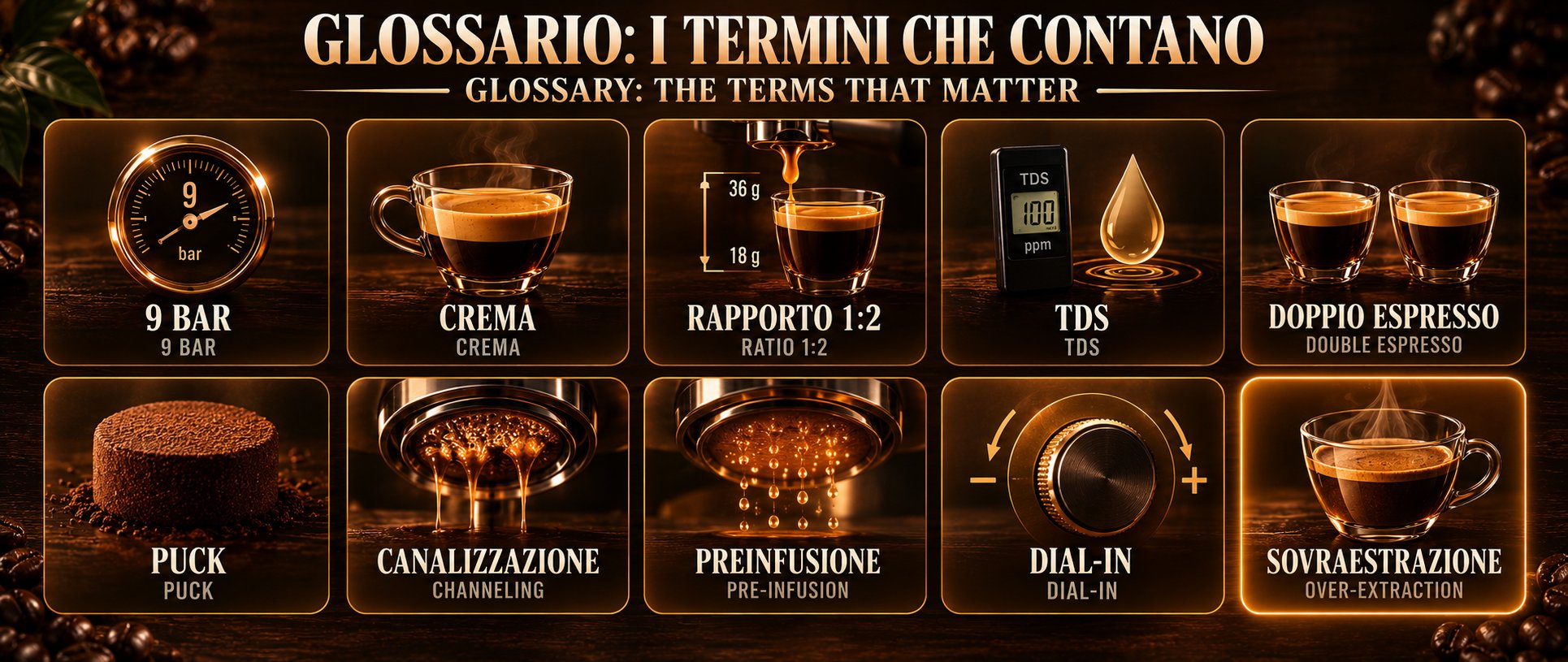
- Ratio: the dose-in to yield relationship. 1:2 means 18 g of coffee for 36 g of extraction, the reference standard.
- Extraction time: the seconds between the start of pumping and the end of the drink. 25–35 s at 9 bar is the espresso reference.
- Pressure: the force pushing water through the coffee bed. 9 bar is the industry and specialty reference.
- Pre-infusion: the initial low-pressure or low-flow phase that wets the coffee before full extraction. Many machines provide it, others do not.
- Crema: the layer of CO2 and oils that forms on the surface. Colour and density are indicators of roast and freshness, not of quality alone.
- Under- and over-extraction: an extraction that pulls too little (sour, astringent, thin cup) or too much (harsh bitterness, dry, flat cup).
- Dial-in: the cycle of small adjustments to the grind, and if needed dose and temperature, to land on a reference extraction.
Sensory evaluation: the cupping language
The terms of the evaluation language, used in cupping and in reading roaster cupping sheets.
Knowing them lets you translate cup comments into concrete roast and extraction parameters.
- Score: the 100-point rating given to a coffee under the SCA protocol. 80+ is specialty grade.
- Cupping: the standardised tasting of ground coffee in cups, for direct comparison between lots.
- Aromatic profile: the set of notes perceived in the cup: fruit, floral, spice, chocolate, hazelnut.
- Acidity: the sense of freshness and liveliness on the palate. It is not the same as sharpness — well-integrated acidity is a sign of quality.
- Sweetness: the sugar-like perception that carries the notes. Judged together with body and aftertaste.
- Body: the weight and texture of the liquid on the palate, from light to creamy to dense.
- Aftertaste: the perception that remains after swallowing. In a well-extracted coffee it can be clean and persistent.
- Clean cup: a cup where the notes are defined and the finish matches the expected profile, with no perceptible defects.
- Defects: negative signals from roast or extraction: sour, harsh bitterness, astringent, roasty, fermented.
With these terms you can read a roaster’s sheet, describe an extraction and compare lots with a shared language.
To put them into practice, the site’s guides on dial-in and water: guides.
Technical coffee definitions are collected in Wikipedia: Espresso.
Note: Some links on this site are affiliate links: if you buy through them we may earn a commission at no extra cost to you. Affiliate links are marked and never influence our recommendations.