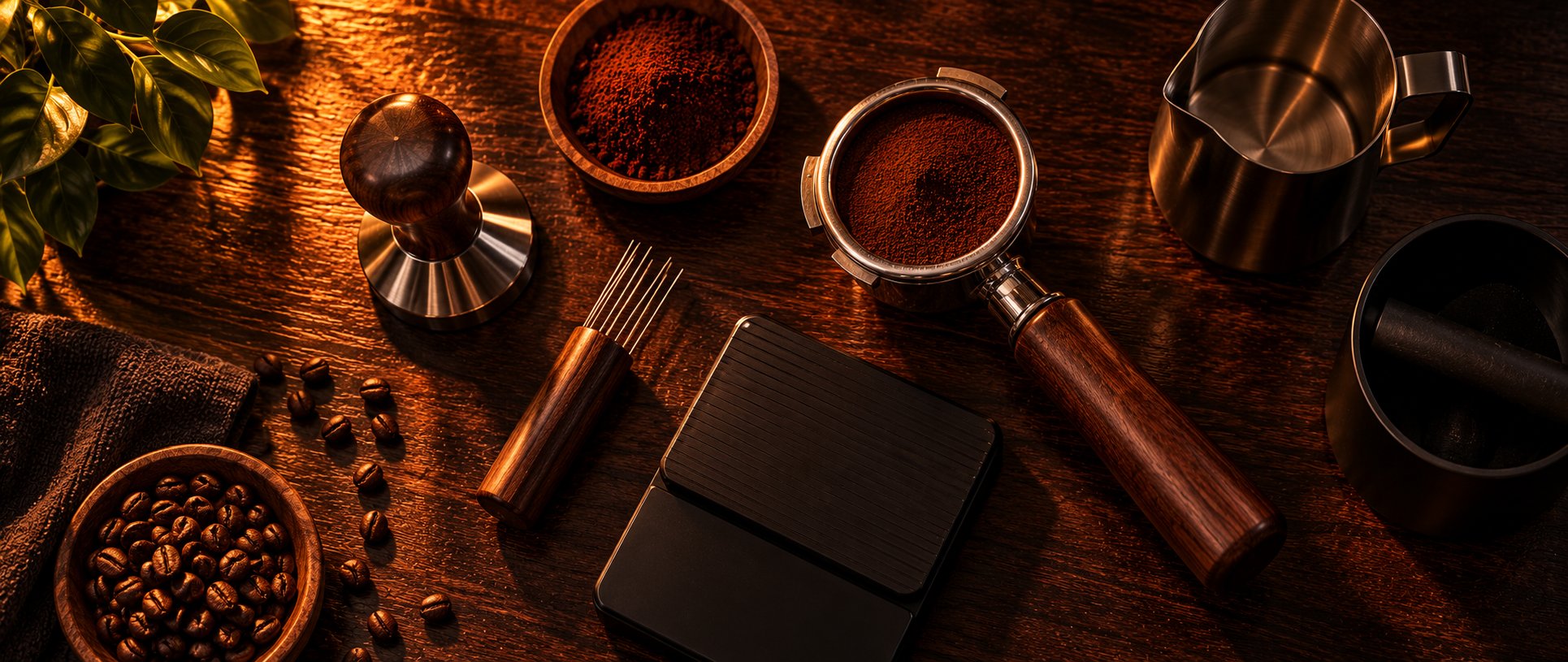
Some espresso accessories look optional, but they change what ends up in the cup: an accurate dose, an even distribution, a measurable extraction. This guide walks through the essentials — tamper, WDT tool, portafilter, scale and timer — with indicative prices and a proposal for a complete setup under €100. The method is the same as for the espresso itself: measure, repeat, improve one variable at a time.
- Buy the scale first: 0.1 g resolution, real-time response, €35–50. An entry-level tamper and WDT tool are enough to start; a 0.1 g scale is not.
- The core trio — tamper, WDT tool, scale — covers most of the immediate improvement in the cup. The rest is maintenance and practice.
- A complete bench setup with entry-level models costs €65–95, under €100; stepping up to a premium scale brings it to €90–125.
- Time (25–35 s) and weight (36–40 g) must be read together: a single parameter alone never diagnoses an extraction.
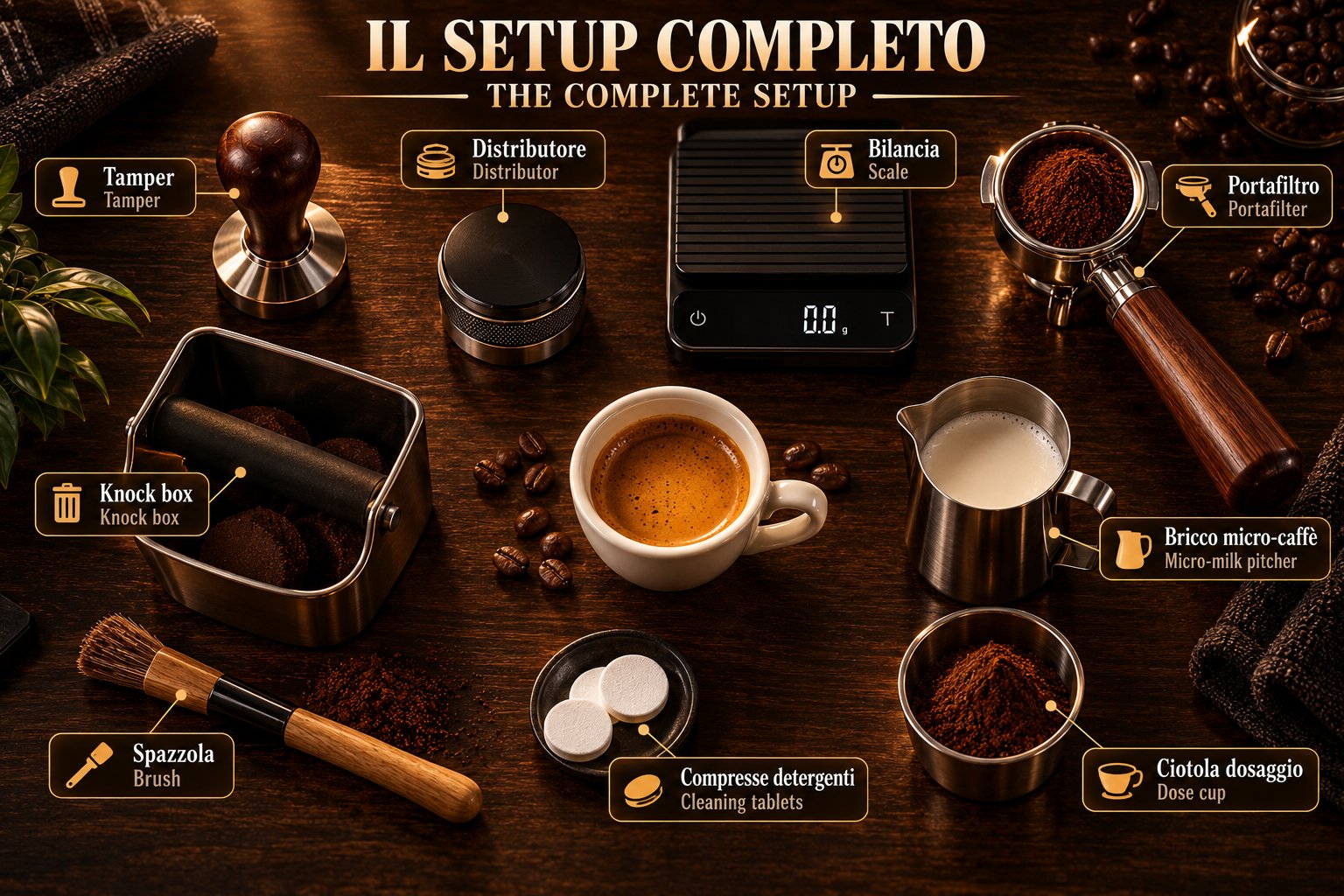
The espresso accessories that change the cup: tamper, WDT, portafilter
Three tools decide what happens between the basket and the water. Each one has a single job, a standard size and an indicative price.
The tamper
The tamper compacts and levels the coffee in the basket, creating a uniform bed through which water flows evenly. It is not about how much force you apply.
It is about applying the same pressure shot after shot: consistency is the parameter that actually matters. A good tamper weighs on average 350–400 g, has a flat base, and a diameter matched to the basket.
58 mm is the standard; compact machines use 54 or 51 mm. Prices typically run from €15 to €40 depending on materials and surface treatment.
The WDT tool
The WDT tool is a device with 15–20 fine needles. It breaks up clumps and distributes the grounds in the basket before tamping.
An even distribution reduces the risk of channeling during extraction — those fast-flowing paths where water rushes ahead of the rest. It is also the cheapest item on the list: €10–20 on average.
The portafilter
The 58 mm portafilter is the standard that separates entry-level machines from enthusiast ones: you will find it on E61-group machines and on most mid-range semiautomatics.
Compact models use 54 mm or 51 mm portafilters, in which case matching baskets and tampers are all you need. A replacement portafilter costs on average €20–60 depending on material and locking mechanism.
It is worth keeping one in reserve, together with a blind basket for backflushing.
The extras: cupping cup and purge station
Round out the trio with a cupping cup: white ceramic, 30–40 ml, used to read crema colour and liquid density without distractions. It costs €5–15 on average.
Optional but useful is the purge station: a metal base to set the portafilter on after backflushing, so water does not drip onto the worktop. It costs €20–40 on average and becomes handy once you rotate more than one portafilter.
For a technical reference on extraction tools and accessories, see Wikipedia: Espresso.
Scale and timer: make the extraction measurable
The scale is the accessory that changes how you work the most. Measuring your dose — about 18 g — and your yield, 36–40 g on a 1:2 ratio, in grams instead of by eye makes dial-in repeatable.
With the same dose, grind and temperature, two extractions should give the same result. A scale suitable for espresso must resolve 0.1 g and respond in real time.
It should have a built-in timer that starts when the scale registers the first gram of extraction. Suitable models cost on average €30–80.
A standalone timer is a useful backup when the scale is out of reach. The principle stays the same: time (25–35 seconds) and weight (36–40 g) must be read together, because a single parameter is not enough to diagnose an extraction.
Those who want to track flow over time can look at a flowmeter, €10–20 — an extra step that is not essential at the start.
Maintenance rules for bench tools
- The scale should be calibrated periodically — many models do it automatically on start-up, and a check with a 100 g weight takes seconds — and zeroed before every extraction.
- The WDT tool should be cleaned after use, because fine grounds stick to the needles and reduce its effectiveness.
- The tamper should be kept clean and dry, because a deformed pad or dried residue creates an uneven bed before compaction even starts.
The sub-€100 setup: buy the scale first
If the budget is tight, the practical rule is to buy the scale first and the rest after: an entry-level tamper and WDT tool are enough to start, a 0.1 g scale is not.
Indicative prices for a complete bench setup:
| Accessory | Function | Indicative price |
|---|---|---|
| Tamper 58 mm, 350–400 g | Compact and level the coffee | €15–20 |
| WDT tool | Distribute the grounds | €10–15 |
| 0.1 g scale with timer | Measure dose and yield | €35–50 |
| Cupping cup | Read the crema | €5–10 |
With entry-level models the total is indicatively €65–95, so under €100; stepping up to a premium scale (€60–80) brings the total to €90–125.
Replacement portafilters, the purge station and machine parts are budgeted separately, since they are machine components rather than bench accessories (see equipment).
Once the basic setup is in place, the upgrade order that makes the most sense is: a scale with finer resolution, a second portafilter to work with in rotation — one being cleaned while the other is ready — and the purge station. The WDT tool and the cupping cup are already on the table from week one.
With a tamper, a WDT tool and a scale you cover most of the immediate improvement in the cup; the rest is maintenance and practice. The full overview of the tools covered here is in tools.
Note: Some links on this site are affiliate links: if you buy through them we may earn a commission at no extra cost to you. Affiliate links are marked and never influence our recommendations.