What is the espresso cost at home compared to the bar? There is no single answer: it depends on how many cups you drink a day, what coffee you use, and what you have already invested.
The arithmetic is simple and uses indicative numbers: cost per cup, upfront investment, and the point at which home espresso starts to make sense.
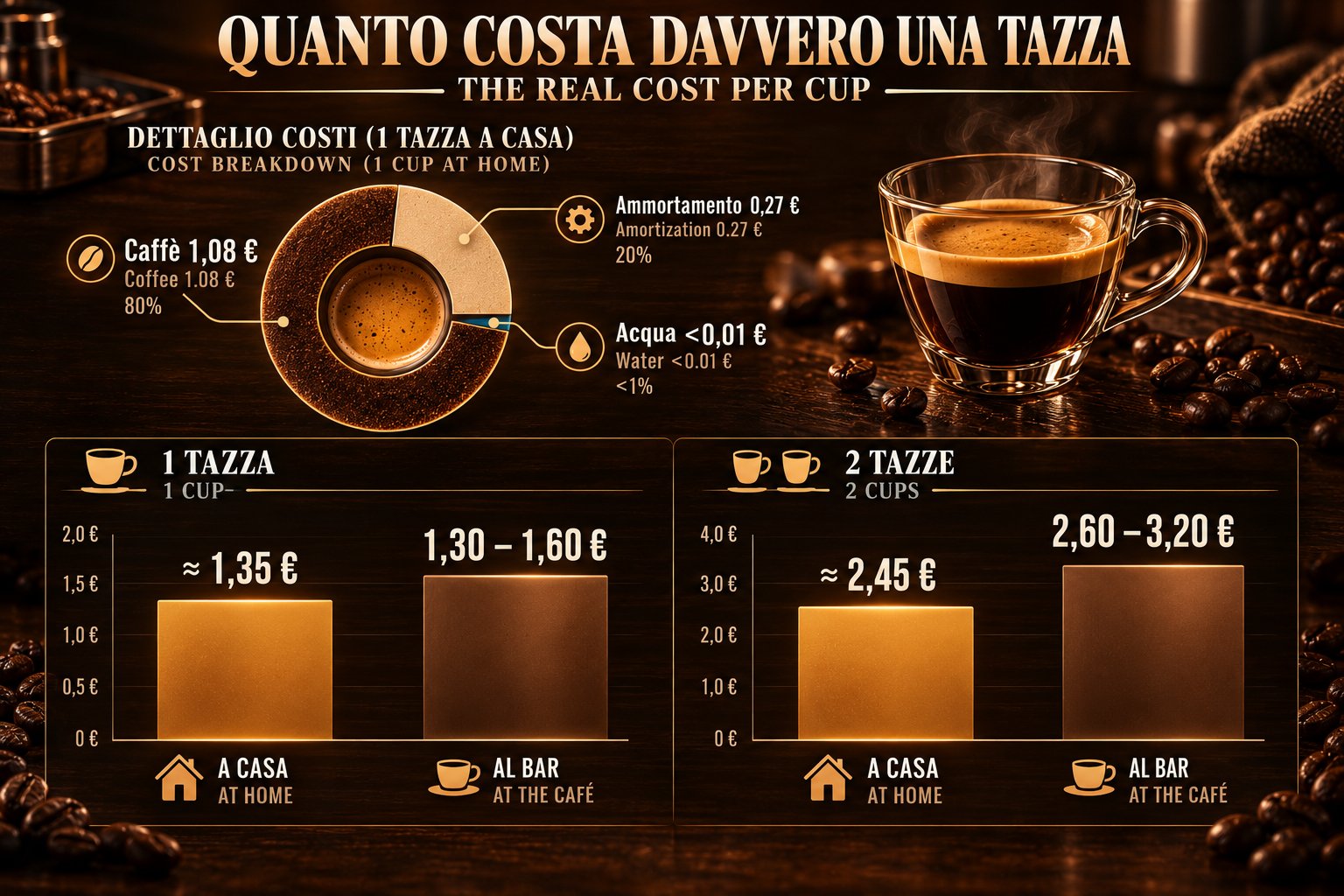
Table of contents
- With specialty coffee the per-cup cost at home is indicatively €1–1.50: coffee is the dominant item, water and electricity are negligible.
- A working minimal setup costs about €500–520; depreciated over five years at one cup a day it adds ~€0.27 per cup.
- Under two cups a day home espresso is mostly a question of quality and control; from the second coffee it is also a question of price.
The espresso cost at home per cup: coffee is the dominant item
The coffee: the biggest item
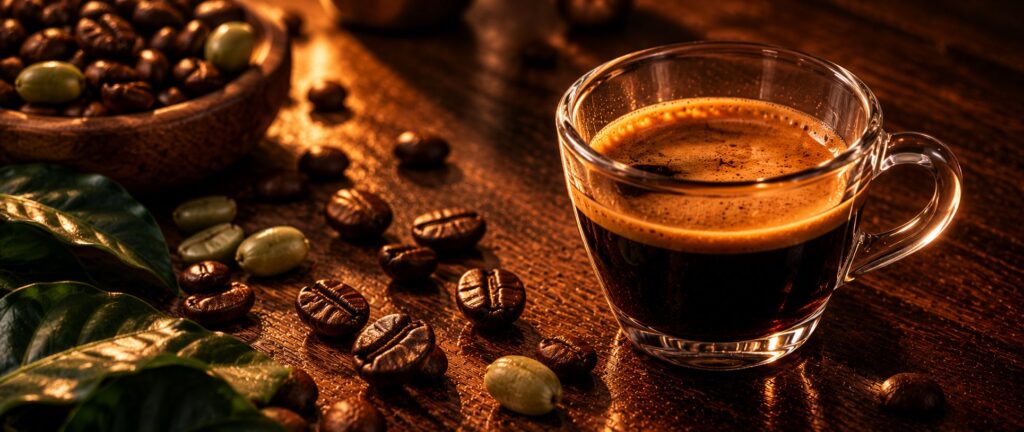
A 250 g bag of specialty coffee costs on average €12–20; a mid-quality commercial coffee, €6–10. A double espresso uses about 18 g of coffee.
With a €15/250 g bag the cost per cup is about €1.08 (18/250 × 15); with €20 it rises to €1.44; with €12 it drops to €0.86.
Coffee is by far the biggest item in the per-cup cost.
| Type of coffee | 250 g price (indicative) | Cost per 18 g double |
|---|---|---|
| Specialty | €12–20 | €0.86–1.44 |
| Mid quality | €8–12 | €0.58–0.86 |
| Commercial | €5–8 | €0.36–0.58 |
Water and electricity: negligible
Extracting one espresso takes a few millilitres of water and a few watt-hours of electricity — on average less than a cent per cup, provided you use compliant water (TDS 80–120 ppm) without buying it bottled.
The per-cup total at home with specialty coffee is therefore typically €1–1.50.
The hidden costs
They stay low anyway: descaling agent and cleaning tablets come to a few euros a year on average; a filtration system (cartridges or a water bottle) is a €50–150 investment with filter replacement every 6–12 months.
The real variable cost, for those who drink milk drinks, is milk — and that is where the comparison with the bar shifts, as you will see below.
The comparison with the bar
At the bar, an espresso in Italy costs on average €1.20–1.50 in big cities and €1.50–2.00 in many tourist areas; a cappuccino €1.50–2.50.
In purely per-cup terms the gap is smaller than you might think: at home you save most when it comes to milk drinks.
Coffee cost and extraction parameters are documented by the Specialty Coffee Association.
The upfront investment: machine, grinder, accessories
The machine
An entry-level vibration-pump semiautomatic starts at €200–400; an E61 model with a copper boiler sits on average between €600 and €1,500; high-end lever machines cost more still.
The grinder
The grinder is the second item: an entry-level conical €100–200, a 40–48 mm flat burr €300–600, a 64 mm flat burr €800–1,500. Accessories (tamper, WDT, scale) add €65–120.
Depreciation over five years
In short: a working minimal setup (€300 machine, €150 grinder, €70 accessories) costs on average about €500–520; a refined one (€800 machine, €500 grinder, €100 accessories) around €1,400.
Depreciation: over five years, at one cup a day, €500 spread over 1,825 cups adds about €0.27 per cup; at two cups a day it drops to €0.14.
Second-hand: less outlay, more checks
The second-hand market is an alternative worth considering: E61-group machines and 64 mm flat-burr grinders often circulate in good condition.
With the right checks (stable pump, burrs with no play, boiler with no visible scale) they can cut the initial outlay by on average 20–40%.
The risk, as always, is the lack of warranty and the difficulty of verifying internal condition.
When it pays off: the arithmetic per cup
The arithmetic per scenario
One cup a day → about €1.35 at home (€1.08 coffee + €0.27 depreciation) versus €1.30–1.60 at the bar: substantially a tie, and the payback depends on local prices.
Two cups a day → 2 × (1.08 + 0.14) ≈ €2.45 versus €2.60–3.20 at the bar: from here, home espresso wins on average from day one.
At three or more cups a day the advantage becomes clear, and it grows if you drink cappuccino often: 0.2–0.3 L of milk costs on average €0.30–0.50 at home against €1.50–2.50 at the bar.
The variables that move the numbers
The numbers change with the usage pattern. If you only drink at home on weekdays, the arithmetic applies only to home cups; if the coffee is shared with the family, the depreciation spreads even thinner.
And one variable the arithmetic does not catch: some roasters apply more favourable per-kg prices on 1 kg formats or subscriptions, pushing the per-cup cost below the 250 g bag rate.
Beyond the numbers, there are variables the arithmetic does not capture: freshness (at home the coffee is ground at the moment, at the bar not always), control over ratio and grind, and the ability to try different origins without a per-cup surcharge.
And one limit to consider: at the bar the price includes service, professional equipment and the barista’s skill — things you have to reproduce at home with maintenance and practice.
In short: under two cups a day, home espresso is mostly about quality and control; from the second or third coffee it is also about price. For the guides on parameters and maintenance that underpin this arithmetic, see the guides on the site.
The minimum setup for the math (selected from official specs)
| Product | Feature | Best for | |
|---|---|---|---|
| De'Longhi Dedica EC685 | Thermoblock, compact | The entry machine in the numbers | View on Amazon |
| Gaggia MD15 | Steel conical burrs | The budget grinder in the numbers | View on Amazon |
| Diyife scale with timer | 0.1 g, rechargeable | Weighing without spending much | View on Amazon |
The honest math: coffee, cups, and the amortisation trap
Verdict: the classic mistake is dividing the machine price by cups “you will make”. Multiply by the cups you make today: gear pays back on consumption, not on promises.
The honest per-cup bill has three lines: coffee (the dominant one, as above), water and power (negligible, cents per year with filtered tap water), and spares. The fourth line most people skip: descaling and gaskets.
A clean worked example: two people, four shots on workdays, twenty days a month, roughly 960 cups a year. At 7 g per shot and coffee at 3 cents per gram, the bean bill alone runs near €200 a year.
That is the whole calculation, and it does not change with your machine brand.
If you start from pods: the same cup often costs three times what loose beans cost, and machine amortisation becomes the easy part of the comparison. For consistency, price-against-spare-parts is the same criterion behind the site’s selections, like the machines under €300.
Home versus café: the comparison without ideology
Verdict: home wins on cost per cup, loses on time and on milk. The café sells your time and someone else’s consistency, not just coffee.
For espresso only, home economics are simply arithmetic above two cups a day. For milk drinks, frothing at home takes a pitcher, skill and cleaning; people who do not want those pay the bar for a service, not a beverage.
A practical compromise for many people is: home for weekday espresso, café for weekend cappuccino. In that model the real saving lives in your water and in buying fresh beans, not in owning the priciest machine.
Resale Value After Two Years
Verdict: a well-kept entry machine is still worth half price after two years. A superautomatic in the same state is worth little more than its brew group.
Simple semiautomatics have two eager buyers: September beginners and students moving out. A common brand with catalogue spares resells within a week.
This changes the hobby’s real cost: if you plan to resell, your entry fee is not the purchase price but the resale gap. It is why buying a good used semiautomatic often beats new-and-kept over two years.
Frequently asked questions
Is making espresso at home worth it versus the bar?
It depends on how many cups you drink: at 1 cup a day you are at substantial parity (about 1.35 euros at home versus 1.30–1.60 at the bar), and it is mostly a matter of quality and control.
From 2 cups a day the numbers tip in favor of home (about 2.45 versus 2.60–3.20), and the advantage grows with milk drinks.
How much does a homemade espresso cost per cup?
With specialty coffee, indicatively between 1 and 1.5 euros: the dominant cost is the coffee (18 g for a double), while water and electricity add less than 1 cent a cup.
With mid-quality coffee you drop under 86 cents.
How long does it take to pay off a home espresso machine?
With a minimal setup of about 500–520 euros amortized over 5 years, the equipment adds about 0.27 euros per cup at one cup a day, dropping to 0.14 at two.
Where the break-even with the bar sits depends on local prices.
Go deeper: how to make great espresso, dial-in from scratch, water for espresso.
More useful spares and accessories for this article
| Product | Feature | For whom | |
|---|---|---|---|
| Severin electric milk frother | Hot and cold, stainless | Cappuccino without the steam wand | View on Amazon |
| 58 mm tamper | Steel, constant pressure | A flat, square tamp every time | View on Amazon |
| Borbone ESE pods Light 150 | Compostable, -50% caffeine | ESE without the sleepless night | View on Amazon |
| Gaggia Classic Pro | 58 mm brass group, parts everywhere | The buy-it-for-now upgrade | View on Amazon |
| Tipre scale with timer | 0.1 g / 2 kg, timer | Weigh dose and yield from day one | View on Amazon |
| Flintronic TDS meter | Digital, ±2% | Measure your water first | View on Amazon |
| WECOOK Paola 1-cup | Aluminium, single serving | One cup, zero waste | View on Amazon |
| Set 12 porcelain cups | 80 ml, dishwasher safe | Espresso deserves proper cups | View on Amazon |
| Airtight jar 1.5 L | Steel, holds 650 g | The week's supply, sealed | View on Amazon |
As an Amazon Associate I earn from qualifying purchases. Note: some links on this site are affiliate links: if you buy through them, I may earn a commission at no extra cost to you. Affiliate links never influence my recommendations.