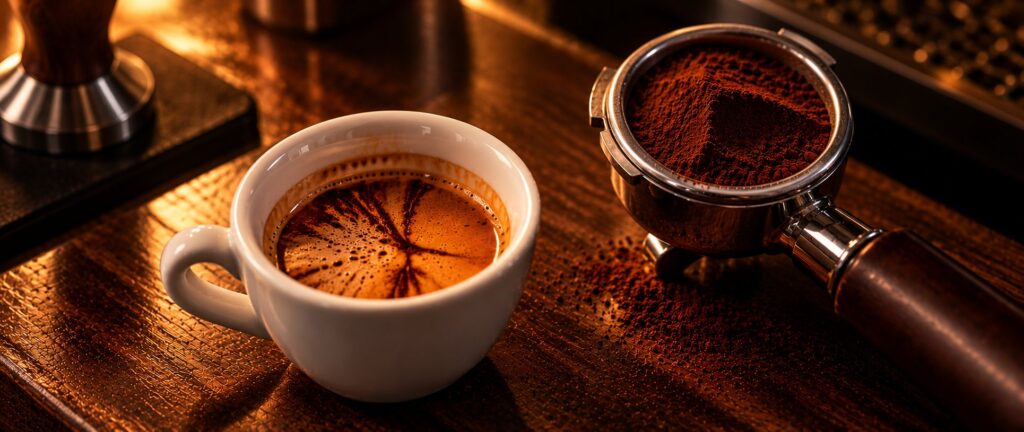
Water for espresso is the main component of the drink: it makes up around 98% of the liquid that reaches the cup, and the minerals dissolved in it are extracted along with the coffee’s compounds.
Choosing the right water for your espresso machine is therefore not a detail — it is a dial-in variable in its own right. It affects flavor, body, and how long the machine lasts.
This guide explains why hardness and TDS matter, what the reference targets are in specialty practice, and how to dose gypsum and calcite to build brewing water from reverse osmosis (RO) water.
- Three targets: TDS 80–120 ppm, hardness (CaCO3) 50–75 ppm, pH 7–7.5.
- RO water starts at nearly zero minerals: re-mineralize with gypsum and calcite dissolved in master solutions, never dosed dry into the jug.
- Controlled hardness stretches your descaling cycle: from 3 to 6 months.
Why it matters: water for espresso
In the cup, water acts as solvent and carrier: the acidity, sweetness, bitterness, and body you perceive all come from the interaction between dissolved minerals and the coffee’s compounds.
Water that is too soft, with a very low TDS, extracts fewer aromatic compounds and tends to give a flat profile with sharp acidity.
Water that is too hard, by contrast, pushes out bitter and astringent notes and dulls the perceived sweetness. A balanced mineral profile, instead, lets the roast’s aromas express themselves fully.
The second reason is mechanical. Excess calcium carbonate deposits as limescale on the boiler, thermoblock, valves, and gaskets.
It reduces heat transfer and raises energy use. It accelerates pump wear and over time can cause leaks and failures.
At the opposite extreme, water that is almost completely devoid of minerals can be more aggressive on copper and rubber gaskets. This is why the specialty industry treats water as a core part of the setup, on par with the machine and the grinder.
The water quality guidelines published by the Specialty Coffee Association set reference ranges for every parameter.
The TDS target for water for espresso
TDS (Total Dissolved Solids) measures the total amount of dissolved minerals, expressed in mg/L — the equivalent of ppm. For espresso, the reference target sits, on average, between 80 and 120 ppm.
Below 75 ppm the extraction loses body and sweetness; above 150–200 ppm bitter notes emerge more easily and scaling accelerates.
Within this range the most important parameter is hardness, expressed as CaCO3. It should be kept, on average, between 50 and 75 ppm, along with bicarbonates, sulfates, magnesium, and sodium:
| Parameter | Reference range |
|---|---|
| TDS | 80–120 ppm |
| Hardness (CaCO3) | 50–75 ppm |
| pH | 7–7.5 |
| Bicarbonates | 40–60 ppm |
| Sulfates | 8–12 ppm |
| Magnesium | 4–6 ppm |
| Sodium | 10–25 ppm |
How to measure it
At home, a conductivity-based TDS meter gives a quick but approximate reading: it measures conductivity and converts it to ppm, without telling you which salts are actually present.
For a full profile you need a DIY testing kit (typically from around ten euros up) or a laboratory analysis.
In Italy, mains water varies widely from city to city.
In areas with “hard” water, common across much of the North and the Centre, TDS can exceed 200 ppm. In areas with “soft” water it can fall below 80 ppm.
The first step of water dial-in is simply finding out what is actually entering the machine.
If your mains water is out of range
You have three options.
A carbon pre-filter removes chlorine and some metals, but it does not correct hardness.
Reverse osmosis with re-mineralization is the most common specialty solution at home, because it lets you control every parameter.
Bottled mineral water can also work, provided the label shows a suitable TDS — worth verifying with your TDS meter.
You will find filters and RO systems in the equipment section.
The closing rule: hardness is the variable that drives both the cup and the mechanics of the machine.
Gypsum and calcite: dosing water for espresso
RO water starts with almost no minerals (0–10 ppm TDS): to bring it up to target you need what are called water salts.
The two main players are calcite (calcium carbonate, CaCO3), which supplies the calcium hardness and, with dissolved carbon dioxide, the bicarbonates.
Gypsum (calcium sulfate, CaSO4) adds hardness and sulfates.
In smaller amounts come magnesium sulfate, which provides the magnesium, and sodium bicarbonate, which tops up the bicarbonates.
Master solutions: why and how
The practical problem is solubility: gypsum and calcite dissolve poorly in cold water. The established practice is to prepare a master solution for each salt.
Weigh it with a 0.1 g scale and dissolve it in a small amount of warm RO or distilled water (40–60 °C), stirring or shaking.
If the liquid stays cloudy, let it rest for a few hours to a night.
Only then do you combine the master solutions with the RO water, top up to the final volume, and check the TDS.
Pouring dry salts straight into the jug gives unreliable dosing: part of the salt never dissolves, and the profile ends up different from the one you calculated.
The indicative doses per liter are:
| Salt | Indicative dose per liter | Parameter covered |
|---|---|---|
| Calcite (CaCO3) | 50–75 mg | Hardness 50–75 ppm |
| Gypsum (CaSO4) | 10–20 mg | Sulfates 8–15 ppm |
| Sodium bicarbonate | 30–50 mg | Bicarbonates |
| Magnesium sulfate (optional) | 10–20 mg | Magnesium 2–4 ppm |
Adding up the average doses keeps you in the order of 0.1–0.15 g of total salts per liter, with a final TDS inside the reference range.
Treat these values as a starting point: weigh, measure the final TDS, and adjust to land between 80 and 120 ppm.
Store the finished water in a clean, closed container and use it within a few days. Label the jug with the date and the recipe.
Remember that controlled hardness does not eliminate descaling, it just stretches the interval: at 50–75 ppm you can comfortably stay on a six-month cycle instead of three. The role of water in espresso preparation is described in Wikipedia: Espresso.
In short: measure the water you are using, bring TDS and hardness into the ranges above, and prepare your gypsum–calcite mix with master solutions instead of dosing by eye.
Water is the variable that changes least and matters most: ten minutes of preparation a week pays for itself in the cup and in the machine’s lifespan. For 0.1 g scales, TDS meters, and measuring accessories, see the tools section.
Note: Some links on this site are affiliate links: if you buy through them we may earn a commission at no extra cost to you. Affiliate links are marked and never influence our recommendations.