Dial-in is the process of adjusting grind size, dose, and extraction time to get a balanced espresso. Most of the bitter, sour, or choked shots people struggle with come from a small set of repeated mistakes.
This guide walks through the most common dial-in mistakes — from handling grind and dose to using the cup and pressure correctly — and, above all, how to avoid them, closing with a diagnosis table: symptoms, likely causes, and the first correction to try.
The reference parameters (18–20 g dose, 36–40 g output, 25–30 s) are the standard ones described in our guide. Reference parameters for dial-in are standardized by the Specialty Coffee Association.
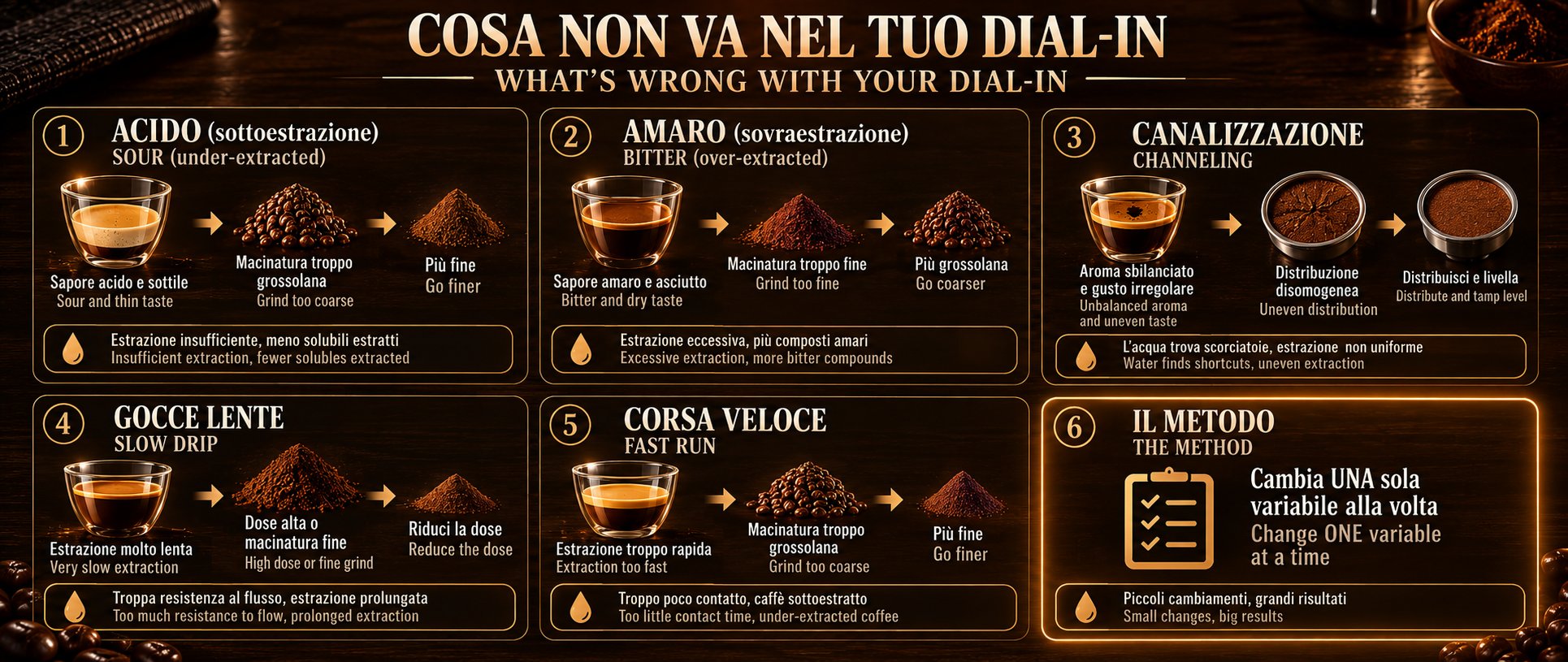
- Change one variable at a time: the grind first, the dose only after. Otherwise it becomes impossible to tell what caused the result.
- Always weigh dose and output — 18–20 g in, 36–40 g out, 1:2 ratio — on a 0.1 g scale. Time is an effect, not a cause.
- Bitter? Coarser. Sour? Finer. Choked? Distribution. The diagnosis table connects each cup symptom to the first correction to try.
Dial-in mistakes: grind and dose
The most frequent error: changing more than one variable at a time
The most frequent error is changing more than one variable at a time: you adjust the grind and, in the same session, the dose and the pre-infusion, and it becomes impossible to tell what caused the result.
The established rule is simple: change the grind, which is the main variable, test it, and only then touch the dose.
The dose should always be weighed with a 0.1 g scale: on average 18–20 g of coffee for a 36–40 g output, a 1:2 ratio.
Dosing by eye is like cooking without a scale: the same dosing cup filled “by sight” can vary by 1–2 g from one shot to the next, and that difference moves the extraction more than most people expect.
Second error: treating the grind setting as fixed
The right grind is always relative to humidity, coffee freshness, lot, and portafilter type. A fresher coffee, with more carbon dioxide and more moisture, often calls for a slightly coarser grind.
A coffee that has already released part of its CO2 may need a finer setting. Before any dial-in session, the practice is to pull two or three test shots and start from your previous setting as a reference, not from scratch.
Third area: the distribution of grounds in the portafilter
An uneven bed of coffee creates channels: water takes the path of least resistance, the extraction is partial and inconsistent, sometimes choking halfway through the shot.
The standard fix is to distribute the grounds with a WDT tool before tamping and to level the bed.
Tamp force matters far less than flatness: on average 10–20 kg is enough; what matters is a uniform, compact bed with no voids.
Cup and pressure: the mistakes you can measure but not taste
Measuring without instruments
The second group of mistakes concerns measurement. Judging an espresso only by the crema color or the time on the display, without weighing the output, is like navigating without instruments: time is an effect, not a cause.
The minimum tool is a scale under the cup that records dose and output. Without it you have two data points out of three — dose and time — and the dose/output ratio, the real indicator of balance, stays unknown.
Pressure: two clarifications
First: home pumps are rated at 9 bar nominal, and in most cases there is nothing to adjust. Pressure is not the dial-in knob — grind size is.
If your machine allows it and you want to go further, a portafilter pressure gauge, on average 10–30 €, lets you verify the real pressure curve, which on many models starts lower and ramps up gradually.
Second clarification: temperature. If the machine has not reached thermal stability, every shot comes out different. The practice is to let the machine warm up and pull one or two waste cycles before judging anything.
Using the wrong basket for the dose
Last mistake in this section: an 18–20 g dose belongs in an 18–20 g basket. Forcing more in, or using less, changes the bed density and the flow time.
The single/double pairing matters too: a recipe built on a double, replicated on a single by changing the dose but not the grind, gives different results and needs re-dialing.
Diagnosis: from bitter, sour, and choked to the first correction
Once dose and output are weighed, diagnosis becomes a procedure. Time should be read as a guide, not a target: with an 18–20 g dose, a 36–40 g output in 25–30 s is the standard reference.
But two 1:2 shots, one at 24 s and one at 31 s, can both be good if the cup is balanced. Taste is the final judge; the table below connects cup symptoms to the most likely causes and the first correction to try.
| Cup symptom | Likely cause | Correction |
|---|---|---|
| Bitter, dry, astringent; time over 35 s | Over-extraction: grind too fine | Coarser grind, one notch at a time |
| Sour, thin, sharp; time under 20 s, low output | Under-extraction: grind too coarse | Finer grind |
| Irregular flow, choked, dribbling | Channeling: poor distribution, stale coffee, static charge, dirty basket | Distribute with WDT, fresher coffee, clean basket and group |
| Dark crema but fast, bitter shot | Partial channeling | Distribution and circuit cleaning |
| Sharp throughout, low sweetness | Water too soft or extraction temperature too low | Check water and machine thermal stability |
On choking specifically, one note: in most cases it is not a machine fault, but a channeling or bed problem. Before suspecting the pump or the valves, clean the basket, check that the group’s shower screen is not clogged, and re-dose while distributing the grounds with the WDT tool.
Only after ruling these causes out do you move on to the machine.
And if the problem persists at equal dose, time, and ratio? The standard hierarchy of suspects is: distribution first, then water, then the machine.
When in doubt, move the grind one notch at a time, always pull two or three shots, and compare them with the previous one: with this method, dial-in stops being an art and becomes a procedure you can reproduce in 15–20 minutes.
In short: one variable at a time, dose and output always weighed, grind size as the main lever, and time as a guide rather than a goal. They are small habits, but they remove the vast majority of defective shots. For scales, portafilter gauges, and WDT tools, see the tools section.
Note: Some links on this site are affiliate links: if you buy through them we may earn a commission at no extra cost to you. Affiliate links are marked and never influence our recommendations.