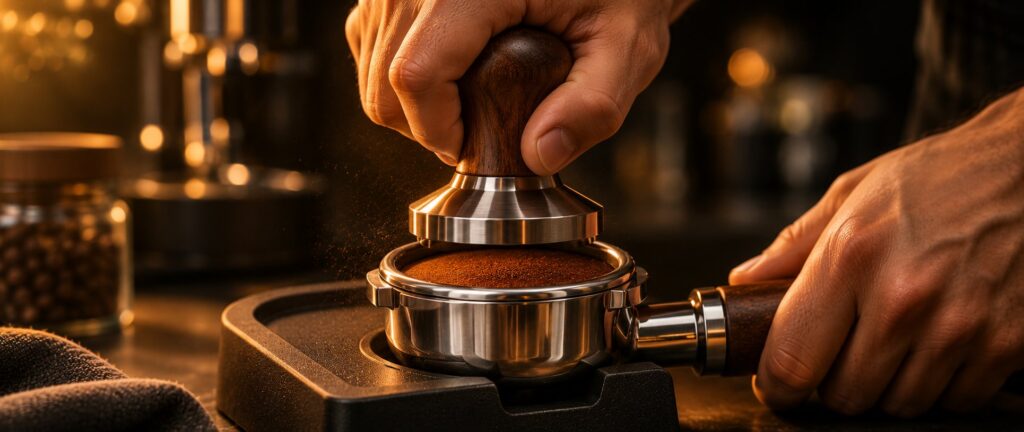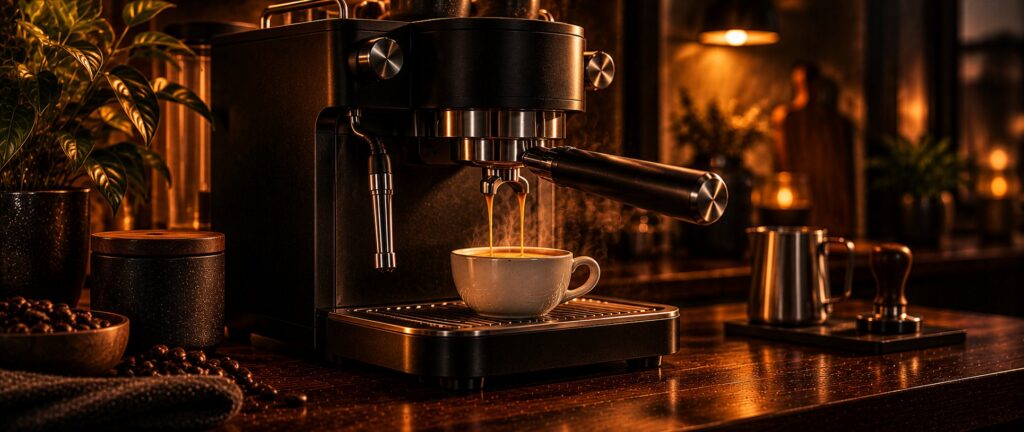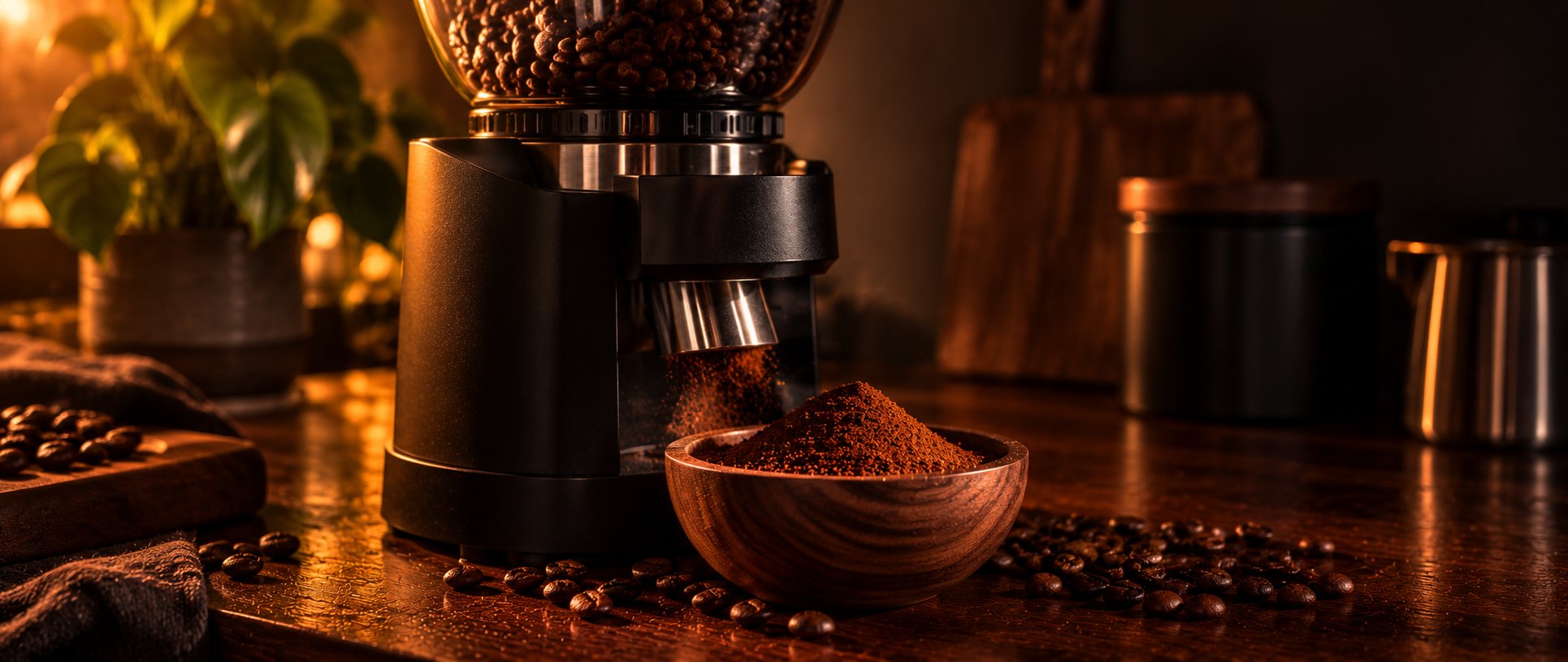
The espresso coffee grinder is the component that gets the least investment and matters the most: it decides how evenly the water moves through the dose.
Here is the difference between flat and conical burrs, what to spend in each tier, and how to match the grinder to the machine you have. Start from one rule: grind uniformity decides everything else.
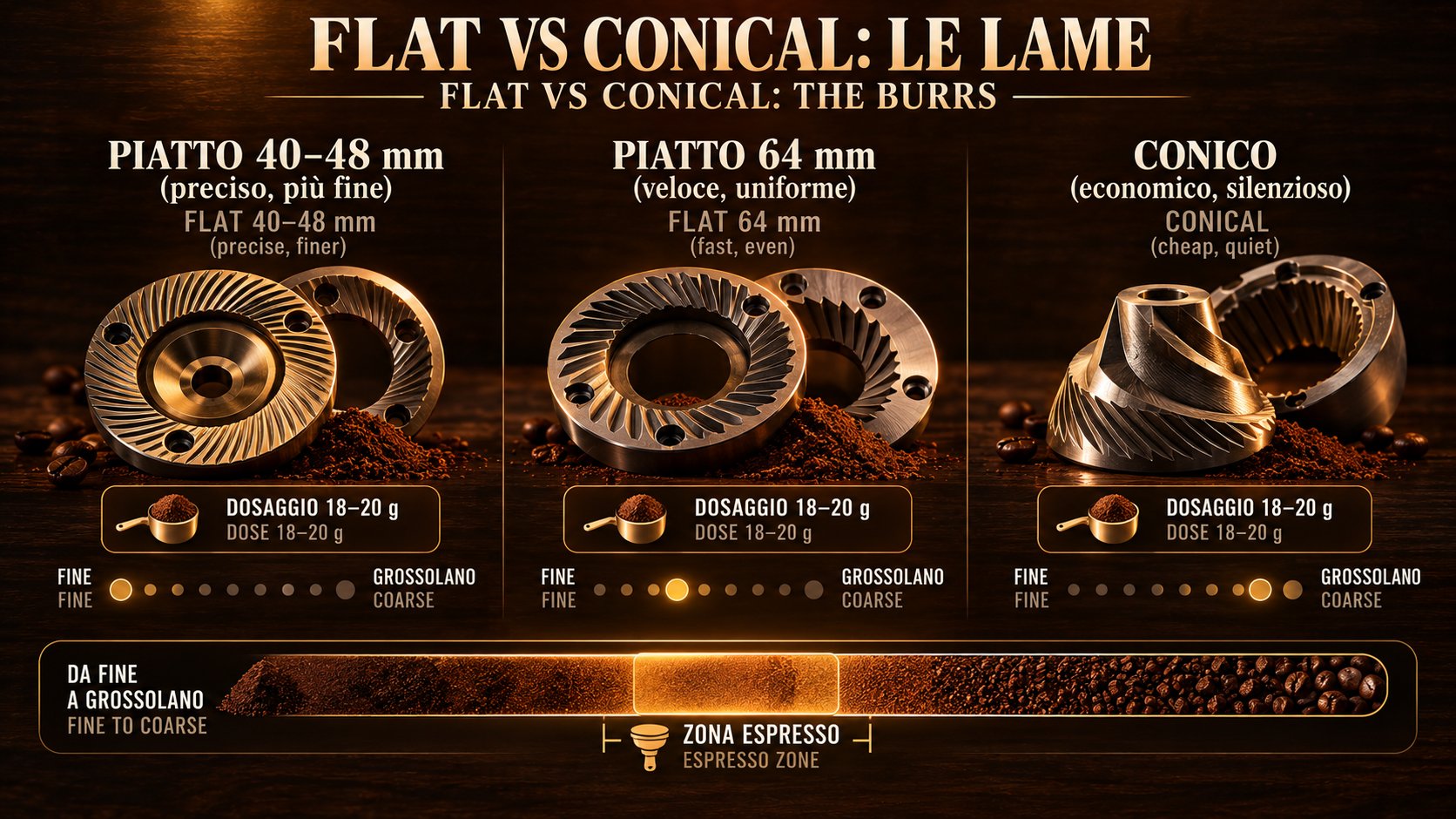
Table of contents
- Flat vs conical is not a quality verdict: build and adjustment matter more than shape. All else equal, well-made flats tend to run more uniform; a good conical is a solid choice.
- Buy for your machine, not for the leftover budget: a 250 euro grinder on a 300 euro machine is the investment you taste.
- Never a blade grinder: random grain sizes cannot be dialed and the cup is always bitter.
Espresso coffee grinder: flat vs conical burrs
Burrs come in two families, and the difference shows up in the cup: in extraction time and in how consistent the shot is.
Flat burrs
Flat burrs close like two concentric discs and cut the bean by shearing: at equal price the grind is more uniform, especially at the fine espresso settings.
The size of flat burrs defines the tiers: 40–48 mm is the value bracket — more uniform than conical, contained price, a bit of heat during grinding.
64 mm is the premium reference: competition-level uniformity, fewer fine fragments, roughly double the price.
Conical burrs
Conical burrs pull the bean downward between a cone and an outer drum. They are the budget option, versatile between filter and espresso. In high-end models they are more than enough for good espresso.
The manual conical grinder stays a niche for espresso. Grinding 18 g takes 60–90 seconds of cranking, and the grind is even but with more scatter at tight settings.
Heat buildup is a recurring argument: on well-made steel burrs it is contained, on ceramic burrs it is almost nil but the lifespan is shorter.
What is excluded
One whole category is out: the blade grinder, the 20–40 euro kitchen grinder. It produces grains of random size, extraction cannot be dialed, and the cup is always the same — bitter and inconsistent.
For espresso, it is simply not an option.
Dosing: by-hand or dose-control
Another axis of choice is dosing: by-hand, grinding straight into the portafilter or a cup, or dose-control, with a hopper and dispenser that grinds a weighed amount into a container.
By-hand keeps the grounds less exposed to air. Dose-control is more convenient for repeated doses.
Espresso coffee grinder by budget
This is what each price range delivers on average, and where each tier stands for espresso:
| Range | What you get on average | For espresso |
|---|---|---|
| 40–100 € | Basic electric conical | Possible, with a margin of error: imprecise setting, more fine fragments |
| 100–200 € | Refined conical or 40 mm flat | The serious entry point |
| 200–400 € | 48 mm flat with fine adjustment | The right tier for most homes |
| 400–800 € | 64 mm flat or premium conical, dose-control | Prosumer uniformity; the used market cuts prices |
| 800 € and up | Low retention, grind timer, premium burrs | For whoever dials in more than once a day |
A practical principle: size the grinder to the machine, not to the leftover budget. On a 300 euro machine, the 250 euro grinder is the investment you taste in the cup. On a 900 euro E61, the 100 euro grinder is the bottleneck.
And as with machines, the used market is alive: 64 mm flat grinders can be found at half price. Check the burrs, absent or minimal axial play, smooth adjustment.
Which grinder: concrete models by price band
The criteria stay the burrs, the adjustment range and the dose stability. In the entry and mid bands, these are the references to evaluate (specs in the gear section):
| Band | Reference model | Burrs | Why |
|---|---|---|---|
| €60–100 | Well-known manual grinders with precision conical burrs (e.g. Timemore C2, HelloGem) | Entry conical | The real budget of this range: build and adjustment quality matter, burr shape alone says nothing. The often-cited Comandante C40 actually lists at ~€220–270 (Nov 2026) — another budget |
| €150–400 | Eureka Mignon Specialita | 55 mm flat | Electric by-hand compromise, tuned for espresso |
| €400 and up | DF64 Pro | 64 mm flat | Premium uniformity; unbeatable used market |
The rule does not change: size the grinder to the machine, not to the leftover budget. On a €300 machine, the €250 grinder is the investment you taste in the cup.
Matching the espresso coffee grinder to your machine
Matching starts from the dose. A 58 mm portafilter works with 18–20 g.
You need a grinder with a sufficient hopper (200–300 g) and a dosing method that keeps the dose stable within ±0.2 g, whether by-hand into a cup or dose-control.
Machines with 54 mm portafilters use 14–16 g doses, where precision matters even more because the percentage error is larger.
If the machine is a superautomatic, the logic flips: the internal grinder does everything. An external grinder makes sense only for a second system, typically filter, or for a quality jump.
In that case you buy the grinder for filter, not for espresso.
Practical details count as much as the burrs: footprint, noise, the hopper and the optional purge station.
Benchtop 64 mm models are 15–25 cm wide. A powerful grinder reaches 90–100 dB, hard to live with in an open kitchen. Empty the hopper daily so the coffee does not age inside.
In a small kitchen, by-hand into a 200 ml container beats a big hopper.
Last check: the grinder must keep pace with the machine. Two or three doubles a day stress nothing; whoever pulls ten shots a day for dial-in needs a motor that does not overheat.
The bottom line: a mid-tier flat-burr grinder paired with an entry machine beats almost any other combination. Buy in sequence — machine, grinder, scale — and upgrade each piece with the budget you have.
The specs of the individual accessories are in the tools section, the buying criteria in the equipment section. Grinder types and extraction parameters are summarized in Wikipedia: Coffee grinder.
Updated: 26-10-2026
The grinders we recommend (selected from official specs)
| Product | Feature | Best for | |
|---|---|---|---|
| Gaggia MD15 | Steel conical burrs, compact | Automatic machines and small kitchens | View on Amazon |
| Eureka Mignon Specialita | Stepless micro-adjustment, quiet | The real espresso step-up | View on Amazon |
| Comandante C40 MK4 | Manual, Nitro Blade burr | The reference manual grinder | View on Amazon |
Go deeper: coffee grinder under €100, extraction errors.
Manual or electric: the practical rule
Verdict: if you grind daily and rush in the morning, a manual grinder is a tax. For one or two cups with time in hand, it is the best value per euro in the category.
The right question is not “which grinds better” but “how much time per cup do you want to lose”.
A decent manual grinder costs 25-40 seconds of arm per dose: multiplied by two shots and a rinse, that is a minute lost every morning.
Electric units have their own hidden tax: retention. Some ground coffee stays in the channels between burrs instead of the basket. At 18 g doses it is tolerable, at 7-9 g it is not.
The clean split, straight from the makers’ own sheets: electric with 40 mm burrs and stepless adjustment for daily multi-cup use, a manual unit of the same burr class when you weigh shots one at a time.
What actually wears out (and what does not)
Verdict: burrs do not die, cheap plastic and wobbly collars do. Hardened steel lasts years; lids and adjustment rings often do not.
The first symptom of a weak build is not dirty grounds but a setting that drifts: the collar slips under vibration and every shot needs a micro-correction. That is where a 60 euro grinder differs from a 150 euro one.
Ask the spec sheet three things: adjustment collar material (metal over plastic), spare parts availability, and the distance from the top burr to the chute. That last gap is retention: shorter path, less coffee left behind.
Hardened burrs survive, in retailer-documented practice, from a few hundred to well over a thousand kilograms of coffee before showing wear. At two cups a day you will retire the grinder before you retire the burrs.
How Often to Clean Your Grinder
Verdict: a dirty grinder tastes rancid within weeks even with excellent beans. That is old oils, not the coffee.
One minute weekly, unplugged: stiff brush on the exposed burr, dry rinse of the chute. Twice a year: remove the top burr per the manual, note the setting number, wipe, refit.
Effervescent burr cleaners help degrease, not sharpen, and the market sells them like real maintenance. For home use they are optional; for oily dark roasts and decaf they are the only practical way to cut the film.
More useful spares and accessories for this article
| Product | Feature | For whom | |
|---|---|---|---|
| Tipre scale with timer | 0.1 g / 2 kg, timer | Weigh dose and yield from day one | View on Amazon |
| 58 mm double-spout portafilter | With double basket | Starting 58 mm with no frills | View on Amazon |
| Gaggia Classic Pro | 58 mm brass group, parts everywhere | The buy-it-for-now upgrade | View on Amazon |
| Borbone ESE pods Light 150 | Compostable, -50% caffeine | ESE without the sleepless night | View on Amazon |
| Flintronic TDS meter | Digital, ±2% | Measure your water first | View on Amazon |
| HG citric acid descaler | 500 ml, citric acid | Protect the machine every 3-6 months | View on Amazon |
| Bialetti Moka Express 2-cup | Aluminium, Italian classic | The right size for one | View on Amazon |
| Set 12 porcelain cups | 80 ml, dishwasher safe | Espresso deserves proper cups | View on Amazon |
| Airtight jar 1.5 L | Steel, holds 650 g | The week's supply, sealed | View on Amazon |
As an Amazon Associate I earn from qualifying purchases. Note: some links on this site are affiliate links: if you buy through them, I may earn a commission at no extra cost to you. Affiliate links never influence my recommendations.